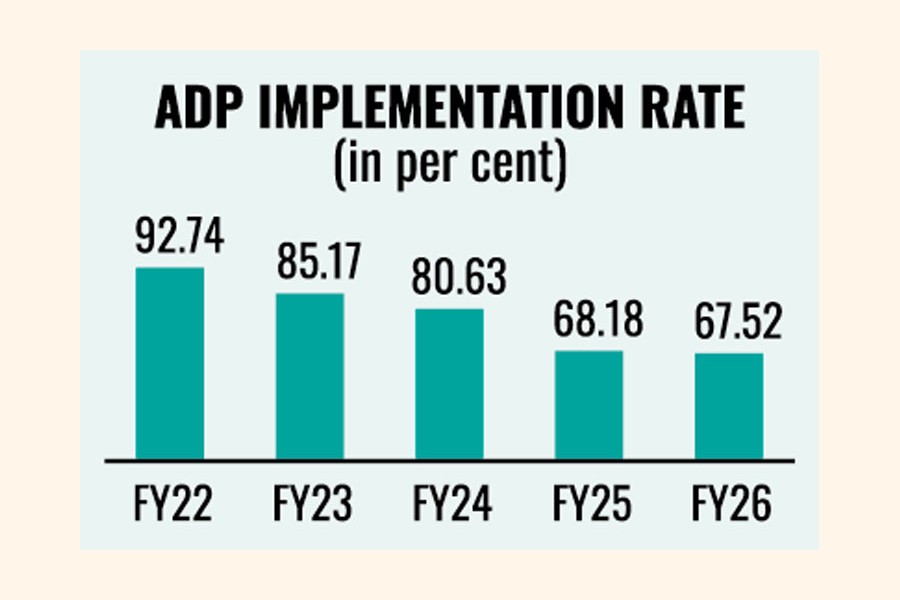
Depressed development works in the transition time are among reasons that diminished Bangladesh's Annual Development Programme (ADP)-implementation rate to a historic low of 67.52 per cent in the past fiscal year, latest official data showed.
Officials think a dismal failure in the vital education sector in implementing the ADP dragged down the development-fund-spending rate in 2025-26.
Government ministries and agencies spent Tk 1.41 trillion worth of funds, 67.52 per cent of total Tk 2.089-trillion ADP outlays, in the just-concluded FY2026, according to data released Thursday by the Implementation Monitoring and Evaluation Division (IMED).
In the previous year, FY2025, the ADP-implementation rate was a bit higher at 68.18 per cent, the IMED data showed.
Development works even under the Covid-19 impact in FY2022 were recorded 92.74 per cent, but the rate went on a slide in the subsequent years.
The rates dropped to 85.17 per cent in the FY2023 and 80.63 per cent in FY2024, the IMED report showed.
The report highlights deepening challenges in the country's domestic fund utilisation and project management.
Government ministries and agencies spent Tk 842.10 billion or 65.79 per cent of their total Tk 1.28-trillion domestic-fund outlay, Tk 498.27 billion or 69.20 per cent of the Tk 720-billion outlay from the project aid, and Tk 70.35 billion or 78.73 per cent of the total Tk 89.36 billion from own resources by the public autonomous and semi-autonomous bodies, the official data showed.
IMED officials said the latest figures marked the second consecutive fiscal year when development spending remained below 70-percent mark, following a 68.18 per cent recorded in FY2024-25 and 67.52 per cent in FY2026.
Historically, ADP implementation rates in Bangladesh regularly exceeded 80 per cent. However, execution capabilities have deteriorated sharply over the past two years, culminating in the lowest execution performance in recent history.
According to the IMED, Technical and Madrasha Education Division, Primary and Mass Education Division, and Secondary and Higher Education Division under the Education Ministry executed only 50.33 per cent, 60.87 per cent and 66.30 per cent respectively during FY2026.
Among top 15 development budget-holders, Energy and Mineral Resources Division implemented the highest 93.73 per cent of its ADP works while Water Resources Ministry 88.77 per cent, Civil Aviation and Tourism Ministry 88.60 per cent, Agriculture Ministry 87.23 per cent, and Power Division of 83.73 per cent.
Officials said between FY2010 and FY2023, ADP implementation consistently ranged between 78 per cent and 96 per cent. Even during severe macroeconomic shocks, such as the initial outbreak of COVID-19 in FY2020, public spending reached over 80 per cent of the revised budget allocation.
The implementation benchmark dropped sharply below 70 per cent in FY2025 to 68.18 per cent and hit a rock-bottom 67.52 per cent in FY2026.
A senior IMED official says mass departures and reassignments of project directors (PDs) following the administrative changes after the August-5 changeover, increased scrutiny, mid-term evaluations, and suspension or downscaling of non-essential or low-priority projects, administrative machinery remaining occupied with state-level governance reforms and election management are some of reasons behind the "historically poor ADP-execution rate".
"Besides, the poor capacity of project-implementing agencies, the slower releases of external credit lines coupled with cautious domestic treasury releases amid austerity pursuit of the government in recent years have affected the overall execution," he adds.
Procurement bottlenecks, delayed tender evaluations, and unresolved land disputes continued to impede progress. Foreign contractor hesitancy and delayed disbursements of foreign aid further constrained megaproject delivery schedules, the IMED official further mentions.
Economists and government officials attribute the slow implementation to structural inefficiencies.
Ministries consistently struggle with timely land acquisition, lengthy procurement processes, and delays in foreign-fund mobilisation.
Policy Exchange Bangladesh Chairman Masrur Reaz has said the inability to utilise allocated development budgets directly impacts infrastructure growth, job creation, and overall economic momentum.
"Without drastic administrative reforms in project monitoring, the trend of under-utilisation is likely to persist in the future days too," he added.
SANEM Executive Director Professor Selim Raihan says implementation of the revised ADP reached just 67.52 percent of the revised allocation in FY2025-26, marking the weakest performance since 1973 and highlighting persistent shortcomings in Bangladesh's public investment management.
"The last interim government faced exceptional challenges, including political instability, law-and-order concerns, administrative disruptions, and the need to review ongoing development projects. However, these difficulties also exposed deep-rooted deficiencies in project design, procurement, institutional coordination, and execution."
Consequently, delays in project implementation have slowed infrastructure-and social-sector development, limited employment creation, weakened business confidence, and reduced the effectiveness of public expenditure in supporting economic growth, he explains the drawbacks.
After the February 2026 election, the newly elected government inherited a significant implementation backlog with limited time left in the fiscal year, the Dhaka University Economics professor has said.
Addressing this situation will require stronger administrative leadership, improved coordination among implementing agencies, expedited procurement and approval processes, and more effective monitoring to accelerate project execution, the SANEM ED suggests.
The FY2025-26 experience demonstrates that higher development allocations alone cannot deliver better outcomes unless accompanied by meaningful improvements in institutional capacity, governance, efficiency, and accountability, he observed.
kabirhumayan10@gmail.com
© 2026 - All Rights with The Financial Express

