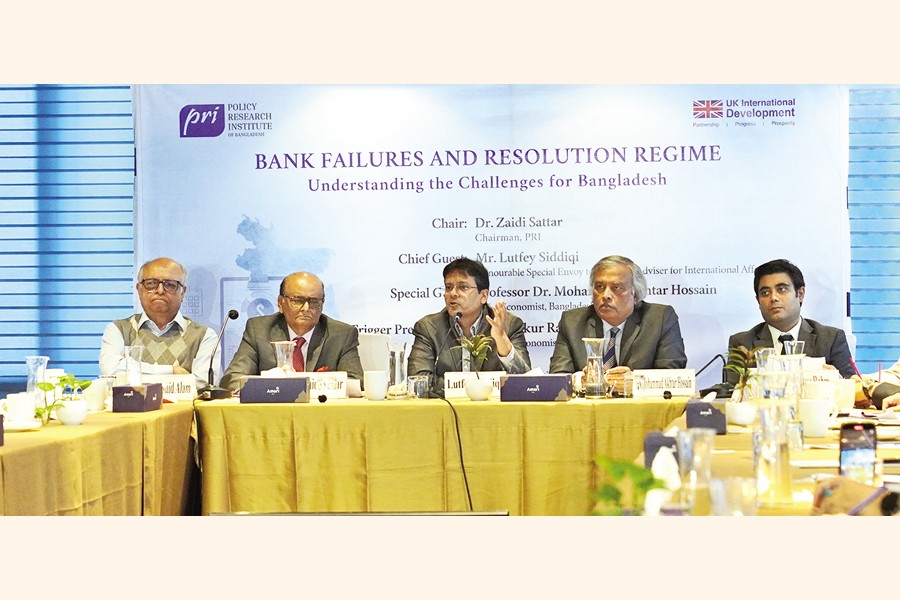
 Lutfey Siddiqi, Special Envoy to the Chief Adviser for International Affairs, attended as the chief guest a discussion titled 'Bank Failures and Resolution Regime: Understanding the Challenges for Bangladesh' at a city hotel on Thursday. Dr. Zaidi Sattar, Chairman of Policy Research Institute of Bangladesh, presided over the event, while Dr. Ashikur Rahman, Principal Economist at PRI, made a keynote presentation.
 An interim government pointsman proposes the formation of a truth commission for rectifying economic crimes and examining how non-performing loans were created under the ousted previous regime.
"We have to form a Truth and Reconciliation Commission on economic crime and see how NPLs were created," special envoy to the chief adviser on international affairs Lutfey Siddiqi told a policy-analysis meet Thursday in Dhaka.
 As the past anomalies pushed many businesses in perils after the changeover, the functionary of the post-uprising government also proposed developing "a proper taxonomy because that is the only way to avoid repeating the mistakes of the past".
Mr. Siddiqi, who attended the meet as chief, stresses that regulators, chief executives, company secretaries and asset-management professionals must be brought under a comprehensive conduct regime to stem the tide of degeneration in trade and business practices.
Citing an example of such financial governance framework, the special envoy to the reformist head of interim government told the audience that the UK was the first to establish the Financial Conduct Authority, which focuses on market conduct and restoring discipline in the financial system.
The Policy Research Institute of Bangladesh (PRI) organised the discussion on bank failures and the country's resolution regime that leads to mergers and acquisition of banks and financial institutions spearheaded by the regulator under bailout package.
Chairman of the PRI Dr Zaidi Sattar presided over the event, held at a city hotel.
On fiscal spaces, he notes that it was shrinking rapidly due to government's rising interest-payment burden against domestic and foreign borrowings.
"We are paying Tk 140 million per hour in interest payments -- more than Tk 3.0 billion a day," he told the meet.
Bangladesh Bank chief economist Dr Akhtar Hossain and the central bank's executive director for bank resolution, Mohammad Zahir Hossain, attended the function as special guests. PRI principal economist Dr Ashikur Rahman delivered the keynote presentation.
The Bangladesh Bank chief economist said there remained ambiguity in macroeconomic management as the government continues to supply capital while the central bank pursues a tight monetary policy.
He mentions that Bangladesh's investment rate stands at around 30 per cent of GDP, while the savings rate about 28 per cent, arguing that higher foreign direct investment is imperative to bridge the gap. "Higher NPLs and higher inflation have barred it."
Bangladesh Bank executive director Mohammad Zahir Hossain told the meet that the central bank was proceeding with bank-resolution efforts on a trial-and-error basis, as there were no prior examples in Bangladesh.
He says a 10-year business plan has already been prepared for the merger-born Samakalito Islami Bank.
Managing Director and CEO of City Bank PLC Mashrur Arefin thinks governance is the central issue in the banking sector.
"Trust is critical," he argues.
"Banks with strong credibility do not typically face liquidity pressures."
He mentions that an estimated Tk 287 trillion remains "under the mattress" and needs to be brought into the formal financial system.
Presenting his keynote, Dr Ashikur Rahman said the costs of an ineffective resolution regime and high levels of non-performing loans are elevated interest rates, high inflation, weak investment and slower growth.
In the PRI policy recommendations, the think-tank calls for stronger stress-testing and supervision, mandatory and robust recovery-planning regimes, and the establishment of a professional, time-bound asset-management company.
Also proposed is the creation and expansion of a resolution fund and deposit-insurance scheme.
The keynote stresses the need for building an effective resolution unit within Bangladesh Bank.
"Create a financial-crime-monitoring unit, too."
jasimharoon@yahoo.com
© 2026 - All Rights with The Financial Express

