An independent UN review team comes again in December to share its assessment report on Bangladesh's LDC graduation to ascertain whether time is ripe for its status change, officials say.
In a sharing session the UN delegation would go for final consultation with Bangladesh's stakeholders, including private sector, before sealing the fate of the country's exit from the world club of least-developed countries (LDCs), they said Friday.
Following government's request, the UN independent consultants for the first time early this month visited Bangladesh and reviewed the country's economic status on way to graduation, earlier slated for late next year.
"The team is due in Dhaka at the end of December. It will share the findings obtained in the first review meeting early this month," says a senior Economic Relations Division (ERD) official.
"The UN team has already discussed matters with the stakeholders early this month. Before finalising its report, it will share the findings among the country's stakeholders during the next visit. At the same time, it will also consult for the second phase before finalising the report," he adds.
Bangladesh is scheduled to graduate from the UN-designated LDC category on November 24, 2026, having met the three set graduation criteria-gross national income (GNI) per capita, human assets index (HAI), and economic and environmental vulnerability index (EVI)-for two consecutive triennials.
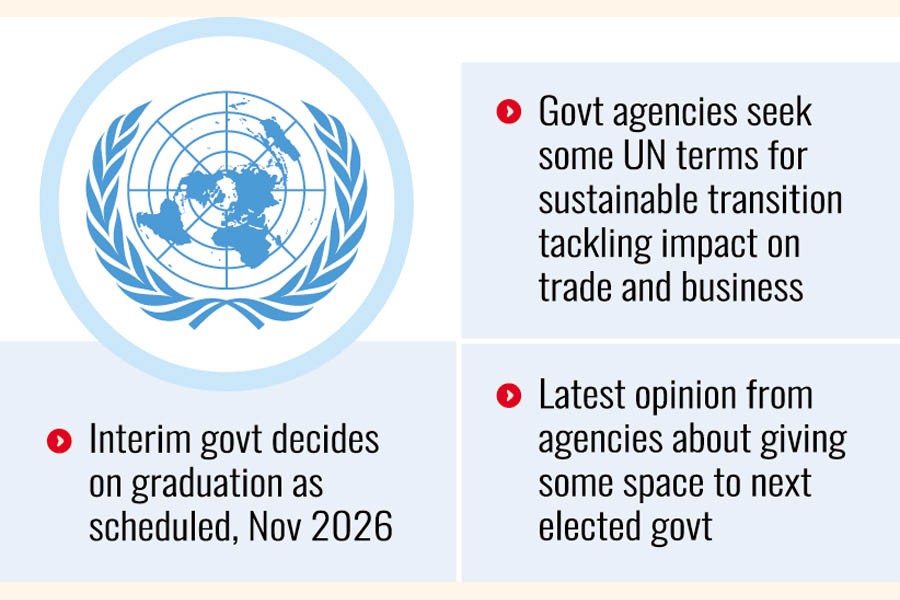
In March last, the cabinet of the interim government had decided on graduation from LDC status to a developing nation as scheduled, in November 2026.
Meanwhile, the private sector strongly stands opposed to the government move regarding graduation to developing nation on explicit grounds of adversities on the economic front.
On government request for an independent evaluation of the graduation prerequisites, a four-member UN mission came to Dhaka and sat with different stakeholders, including private sector, local think-tank, and political leaders, for eliciting opinion on graduation preparedness.
In the last meeting with the UN review team, private and public sectors put mixed opinions on graduation, sources say.
"This interim administration and private sector opined for giving space to the next elected government for final decision," says one source.
Government agencies have also request the UN mission to recommend some terms which will facilitate Bangladesh to have a smooth and sustainable transition considering the possible impact on trade and business.
Since some uncertainty from global and local fronts has emerged, the next political government should have a space to secure the decision on whether Bangladesh will graduate to a developing nation in November next year or not, a government official told the FE.
"The government agencies gave their mixed reaction over on-time graduation as there are new uncertainties like Trump tariff, July uprising and some other local and foreign issues although Bangladesh is in a comfort zone in all three criteria for the graduation," he adds.
Another government official says Bangladesh is in a very better shape on three criteria than other prospective nations -Nepal and Myanmar-on the graduation list. According to the official, Bangladesh has utilised the duty-free-quota-free (DFQF) market-access facilities in the developed nations as an LDC by proving its capacity.
On the other hand, Nepal and Myanmar have been far behind Bangladesh in the DFQF facilities, he notes.
Quoting a WTO report, the Bangladeshi delegation member told The Financial Express that Bangladesh has utilised 71 per cent capacity in DFQF-facility utilisation, while Myanmar used only 25 per cent and Nepal 10 per cent.
"Since Bangladesh has utilised the highest percentage of the facilities, its challenge is bigger than other nations. When the DFQF will be stopped, it could face trouble in market access," the official notes.
"So, we have requested the UN team to highlight those challenges in their report to the UN when it will come back."
© 2026 - All Rights with The Financial Express

