Government work gets going to bring all privately operated buses under a more coordinated system through introducing route-based uniform bus services and promoting electric vehicles (EVs) as part of efforts to modernise Bangladesh's outmoded transport sector.
 Road Transport and Bridges, Railways and Shipping Minister Sheikh Rabiul Alam Thursday rolls out the plans for much-sought-after disciplining of chaotic transport run, especially in the capital city.
"Nowhere in the world is there such a wide variation of vehicles operating on the same routes.
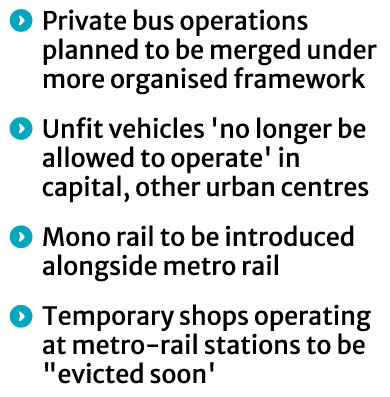
We are working to merge private bus operations under a more organised framework so that commuters can enjoy better and more disciplined services," he says.
The minister was speaking at a dialogue organised by the Bangladesh Secretariat Reporters Forum (BSRF) at its office in the Secretariat on Thursday. BSRF President Masudul Hoque and General Secretary Mohammad Ubaydullah (Badal) were among others present at the programme.
Focusing on the government's push towards cleaner transportation, Mr Islam says electric buses would be encouraged in the years ahead.
However, he acknowledges the economic challenges facing operators.
"An electric bus currently costs between Tk 25 million and Tk 28 million. Bus owners generally require eight to ten trips a day to make their operations financially viable, which remains a challenge for EV buses at present. We are working on addressing these issues."
He says unfit vehicles would no longer be allowed to operate in the capital and other urban centres as the government intensifies efforts to improve road safety and transport discipline.
Under the planned transport-sector reforms, buses operating on the same routes would have a uniform colour scheme and follow designated stoppages instead of picking up and dropping off passengers at will.
"Private operators will be brought under a coordinated system. Buses will not be allowed to stop wherever they wish."
The minister says the government has started works of new route of metro rail. "Mono rail will also be introduced to make transport vibrant."
Referring to the role of the media, Mr Alam says the government and journalists should work in harmony to advance national development goals.
"We are implementing the commitments of the elected government. We have set a target for 180 days and are working to fulfill those commitments," he told the reporters.
The minister acknowledges that institutional weaknesses and various shortcomings continue to pose challenges in governance and implementation.
"You should point out our shortcomings. Constructive criticism helps us move forward. What matters is thinking about the country's interests and bringing about positive changes that will help Bangladesh reach its desired level of development," he says.
On reports regarding soil removal around the Padma Bridge, the minister says some media reports had created misconceptions. He explains that the soil in question had originally been deposited during construction and later required removal to facilitate river navigation.
"It may have appeared that soil near the bridge pillars was being removed, but that was not the case. Journalists should visit the site and present the authentic picture."
The minister also says temporary shops operating at metro-rail stations would be evicted soon as part of efforts to maintain order and improve passenger services.
He notes that journalism itself has evolved significantly over the years, extending well beyond traditional reporting confined to government offices and institutions. "The pattern of journalism has changed, and so have public expectations."
tonmoy.wardad@gmail.com
© 2026 - All Rights with The Financial Express

