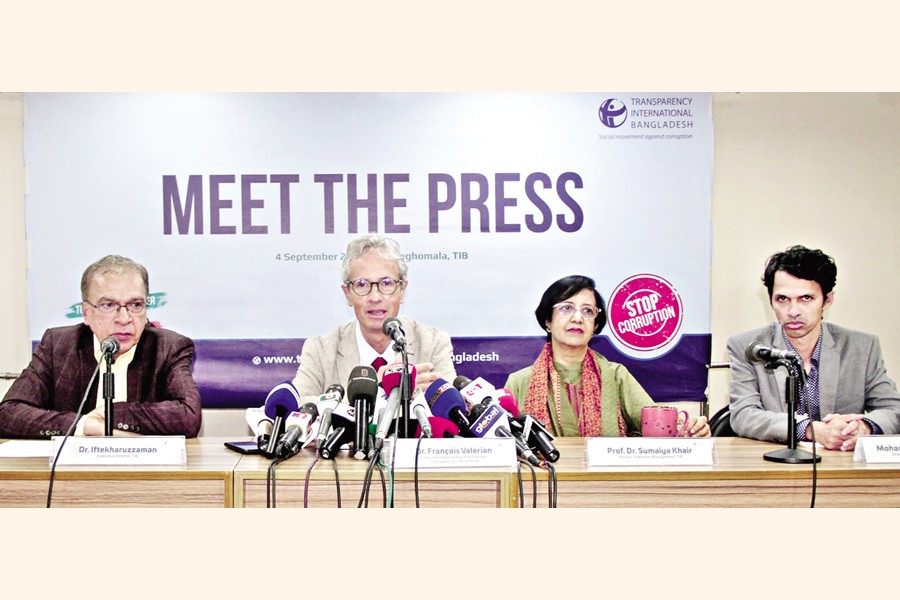
 Transparency International Chair François Valérian speaks at a 'Meet the Press' session during his visit to the Transparency International Bangladesh’s (TIB) Dhaka office on Thursday. TIB Executive Director Dr Iftekharuzzaman was also present. — FE Photo
  Under the authoritarian regime, $16 billion was stolen from Bangladesh on average every year, Transparency International (TI) Chair François Valérian said on Thursday, the last day of his first visit to Dhaka.
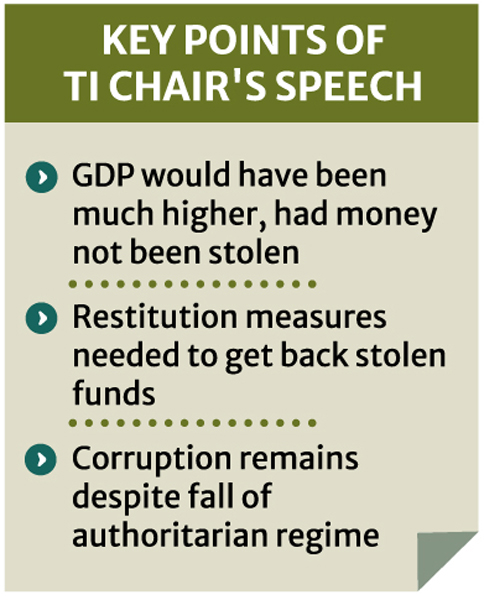
"Had this money not been stolen, Bangladesh's gross domestic product (GDP) would have been much higher and more equitably distributed, helping reduce inequalities.
"It could have also been used far more effectively to fight poverty," he said during a session with journalists at the Transparency International Bangladesh (TIB) office in the capital.
Speaking about the laundering process, he said officials at various levels of power were involved, fuelling the global economy of corruption.
"Worldwide, an estimated one trillion dollars are stolen every year, with money often being laundered from developing countries to developed ones.
"This global economy of corruption effectively destroys the value of money, turning public funds that could generate economic and social value into meaningless private wealth," he explained.
Corruption remained in Bangladesh despite the fall of the authoritarian regime, though reform efforts were underway, he noted.
Speaking about the challenges faced by the interim government, he said, "The challenges are high, and I feel that the interim government is aware and genuinely willing to address those challenges.
"Corruption did not vanish from the country after the fall of the authoritarian regime. But there are reforms that are being worked on. Some of them have started, some of them are being implemented, and that is what counts."
The programme was attended by TIB Executive Director Dr Iftekharuzzaman, Adviser of Executive Management Prof Dr Sumaiya Khair, and Communication and Outreach Director Mohammad Tauhidul Islam.
In the face of a global rise in authoritarianism, the new Bangladesh began its journey with a dream born from unprecedented sacrifices that overthrew the authoritarian rule, the TI chair said.
"To fulfil that dream, it is essential to maintain the continuity of reforms, although corruption still exists even after the fall of the authoritarian government. The fight against it must continue."
He further emphasised the need for global cooperation, adequate civic space, and an independent judiciary to effectively combat corruption.
"Our global movement admires what is happening in Bangladesh. We know the stakes are high and that reforms are ongoing. All these reforms must be sustained.
"There needs to be a sustainable effort that delves deeply into the necessary reforms of the state and into how power is exercised at every level in Bangladesh," he further said.
To prevent the siphoning of public funds, the TI chair said civil society organisations must be aware of stolen assets and put pressure on the government to secure international cooperation.
"Those involved in plundering public money are hiding behind legal entities. We need to identify the individuals behind these entities in every country.
"Only then can the governments of the Global South and Global North cooperate effectively. This cooperation will happen only if the civil society exerts strong pressure and knows where the assets are," he said.
He added, "There must also be restitution measures in the countries to which public money is transferred, so that it can be returned."
In response to a question, Valérian said, "For speaking out against corruption, TIB has always been criticised by those in power. During every government's tenure, TIB has pointed out mistakes and shortcomings and offered criticism.
"Since its founding, no government has refrained from criticising TIB. After the elections in February, the government that comes to power may also feel uncomfortable."
Dr Iftekharuzzaman said, "The average annual outflow of $16 billion from Bangladesh during the rule of the fallen authoritarian government is only a partial estimate; the actual amount is much higher."
He said corruption was the root cause of entrenched inequality in the country under the shadow of authoritarianism.
Power was monopolised to protect corruption, and state institutions were made to facilitate it, he also said.
Over the past 15 years, more than twice the total amount of annual foreign investment - combined with foreign development aid - had been siphoned off through corruption, he noted.
To prevent a recurrence of this situation, two priorities must be emphasised - preventing illicit financial outflows and recovering laundered funds, he said.
"TIB believes the main focus should be on ensuring that no money can be laundered from Bangladesh under any circumstances," he said.
"The process of recovering laundered funds is long-term and highly complex, which is why, globally, only about 1 per cent of laundered funds is ever returned.
"Closing all avenues for money laundering is therefore far more effective and important. With political will and institutional capacity, it is also a more realistic approach," he added.
sajibur@gmail.com
© 2026 - All Rights with The Financial Express

