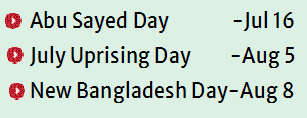
 The interim government has declared Aug 5, the day the Awami League government was toppled by a mass student-led uprising, as "July Mass Uprising Day", reports bdnews24.com.
It also announced that Aug 8, the day the interim government led by Nobel laureate Muhammad Yunus took power, would be known as "Notun Bangladesh Dibosh" or "New Bangladesh Day".
In addition, the nation will observe July 16, the day Abu Sayed was shot dead by police in Rangpur amid the quota reform movement, as "Shaheed Abu Sayed Dibosh," or Martyr Abu Sayed Day.
The Cabinet Division's decisions were issued in separate notices on Wednesday. The notices said that ministries, divisions and other government bodies should observe these days every year with the due respect.
Aug 5 has been listed under category A, and the other two commemorative days under category B.
The government had already shared its decision for Aug 5 to be listed as a public holiday.
The movement demanding a reform of the quota system in government jobs kicked off in the middle of 2024. The protest started by students and job seekers intensified into an anti-government movement and created history by toppling the country's long-term rulers.
Sheikh Hasina, who ruled the country with an iron fist for 15 years, stepped down in the face of the 36-day movement and fled to India.
The movement started at Dhaka University and later spread across the educational institutions in the country.
The Awami League government responded by trying to quell the protests with violence, using bullets, tear gas shells, and batons. It attempted to restrict protests by blocking Facebook and then internet service. However, that plan backfired.
On Jul 16, Abu Sayeed, a student of the English department at Begum Rokeya University was shot dead by police. He has been honoured as the "first martyr" of the movement.
The Awami League government, which ruled for one and a half decades, fell in 20 days in the face of the movement and amid accusations of murder and bloodshed. Hasina and many members of her government were forced to flee the country.
The government published a list of those killed in the July uprising in the form of a gazette, with the number of martyrs at 834. However, a UN investigation on the human rights violations committed during the uprising estimates that more than 1,400 people may have been killed from Jul 1 to Aug 15.
© 2026 - All Rights with The Financial Express

