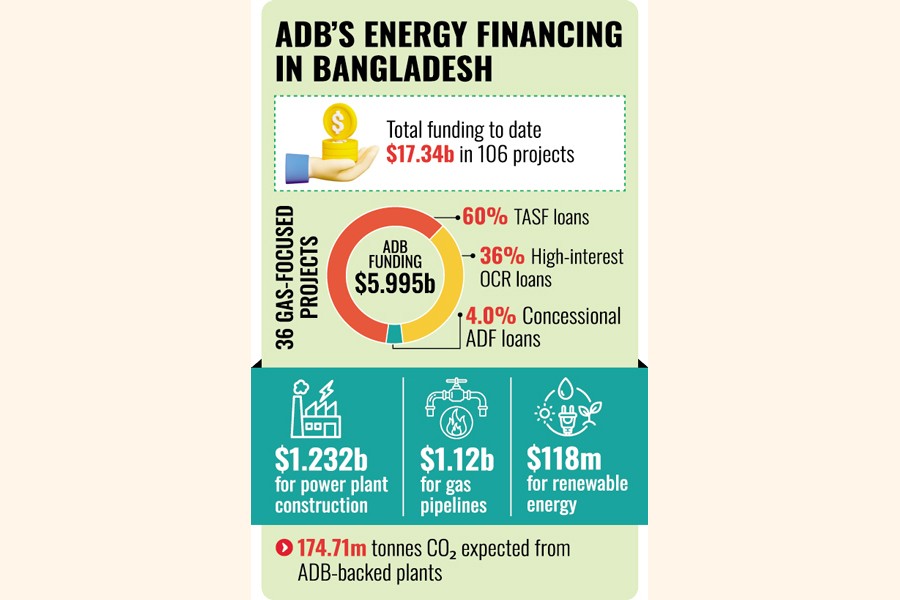
Bangladesh has so far received US$17.34 billion in 106 projects from the Asian Development Bank (ADB), including nearly $6.0 billion for 36 gas-focused schemes that collectively support 3,659MW generation capacity, a new study has revealed.
Civil society groups say this long-standing reliance on fossil fuel lending is now undermining the country's energy security and climate resilience.
The report titled 'MDBs in the Energy Sector of Bangladesh' shows that ADB's gas-related financing has been overwhelmingly loan-driven, with 60 per cent coming from its Technical Assistance Special Fund and 36 per cent from high-interest Ordinary Capital Resources (OCR).
Only 4 per cent, totalling $2.59 million, was provided through concessional Asian Development Fund support.
Presented at the Bangladesh Energy Conference on Sunday, the study argues that this financing pattern has contributed to mounting debt, stranded capacity and avoidable emissions.
Campaigners warn that ADB's fossil-heavy strategy has increased Bangladesh's exposure to fuel shortages, costly capacity payments and high-risk energy infrastructure at a time when global investment is shifting rapidly towards cleaner, cheaper and more resilient alternatives.
The report was presented by Sarmin Akter Bristy, Fossil Fuel Campaigner and Coordinator at the NGO Forum on ADB, during a session moderated by the Forum's Executive Director Rayyan Hassan at the Bangladesh Military Museum on Sunday.
During the years following independence, from 1977 to 1993, ADB assistance focused on gas planning, system upgrades, energy-efficiency measures and the Power System Master Plan, the report notes.
After 2000, the bank shifted towards direct financing of gas-fired power plants and combined-cycle efficiency upgrades, primarily through OCR loans.
High-profile tenders were also initiated for the Sirajganj and Meghnaghat 450 MW gas plants.
Bristy cautioned that ADB's "one-sided, fossil-heavy investment model" has heightened Bangladesh's exposure to fuel shortages, rising debt burdens and escalating climate risks.
Of the total financing, the ADB provided $1.232 billion for power plant construction, $1.12 billion for gas pipelines, $703.6 million for gas sector development, $660 million for planning, $600 million for the Power System Master Plan, and $1.393 billion for other gas-related projects, the study finds.
Four public-sector power plants received $817 million in ADB financing, while $415 million went to private-sector ventures led by US-based GE, Malaysia's Pendeker, Bangladesh's Summit, Japan's JERA in partnership with India's Reliance, and the state-run North West Power Generation Company Ltd (NWPGCL).
Direct financing included $75 million for the 341 MW Bibiyana II plant, $200 million for the Rupsha 800 MW plant, and $500 million for the Reliance Meghnaghat 715 MW facilities.
Azizjst@yahoo.com
© 2026 - All Rights with The Financial Express

