Despite building one of the country's largest agro-based industries in terms of investment and employment, Bangladesh has failed to secure a meaningful share of the global poultry-export market.
While neighbours India and China have expanded shipments to Middle Eastern and Western markets, Bangladesh's overseas footprint remains negligible, analysts and industry insiders said on Tuesday.
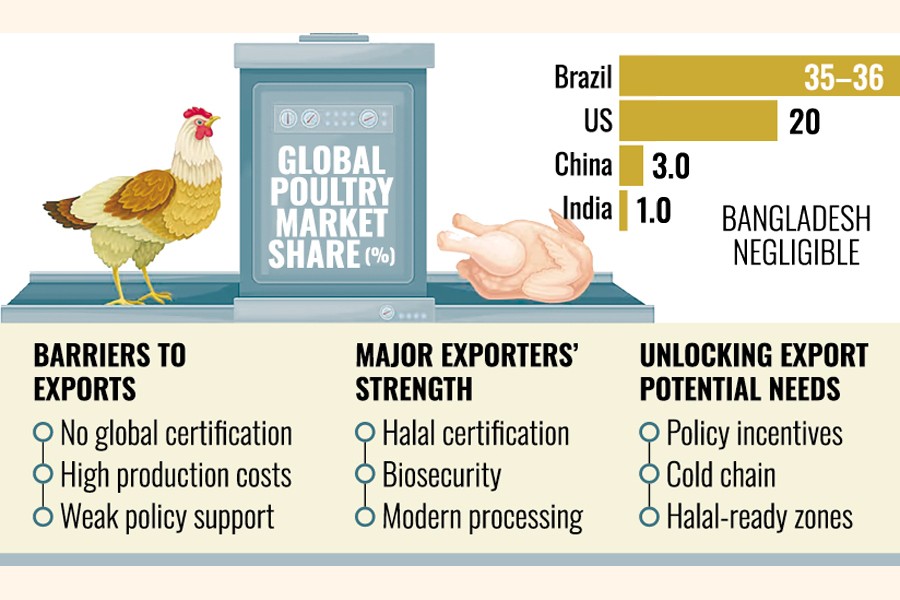
They attribute the shortfall to a combination of weak policy and fiscal support, the absence of internationally recognised certification, and rising production costs that undermine price competitiveness.
As global demand for poultry products continues to grow, stakeholders warn that Bangladesh risks being permanently sidelined unless structural bottlenecks are urgently addressed.
Industry insiders said the lack of standard certification, limited government policy support and challenges in maintaining competitive prices are the main reasons behind the setback.
According to analysts, China currently accounts for nearly 3.0 per cent of the global poultry market, while India holds close to 1.0 per cent.
Brazil dominates the sector with roughly 35-36 per cent of global chicken meat trade, followed by the United States with about a 20 per cent share.
Thailand leads in processed poultry, commanding a 26.3 per cent share of global processed chicken volumes, while Vietnam has emerged as a regional hub, exporting a record 9.0 million breeding chickens in late 2025.
Industry representatives said soaring production costs driven by volatile raw material prices, domestic market instability, and the absence of sustained policy and fiscal support have severely constrained the sector's growth and its ability to compete internationally.
Bangladesh's efforts to expand into the global halal meat market have also faltered for similar reasons, they added.
Dr A B M Khaleduzzaman, Director (Production) at the Department of Livestock Services (DLS), told The Financial Express that the government is now encouraging poultry farmers to adopt good farming practices to prepare farms for producing exportable poultry meat and processed products.
"Bangladesh's poultry industry is strong enough to meet domestic demand for meat and eggs. Now we need to scale up to the international market," he said.
He noted that although a poultry development policy has recently been formulated, additional policy and fiscal incentives are required to stimulate exports.
"When production costs rise, Bangladesh loses price competitiveness in the global arena. With proper policy and fiscal support, the industry can compete in the international export market," Dr Khaleduzzaman added.
Thailand and Vietnam are aggressively targeting markets such as the United Arab Emirates and Saudi Arabia by securing halal certification.
Thai poultry exports to the UAE increased fivefold in early 2025 due to strong demand for certified halal products, industry insiders said.
While Bangladesh struggles, Vietnam and Thailand are investing heavily in biosecurity and processing technologies to bypass highly pathogenic avian influenza (HPAI) restrictions that often disrupt raw meat exports.
Meanwhile, India and China have continued to capture market share as Bangladesh's production costs rise, compounded by the gradual withdrawal of export cash incentives ahead of the country's graduation from least developed country (LDC) status.
"We are losing money on every bird we raise. If this trend continues, the small-scale infrastructure supporting millions of livelihoods will be replaced by monopolies, and our export ambitions will disappear," said a representative of the Bangladesh Poultry Industries Coordination Committee (BPICC).
According to the BPICC, the poultry industry, which started from scratch, has attracted nearly Tk 400 billion in investment and could grow into a Tk 800 billion sector by 2050.
Bangladesh has recently approved the National Poultry Development Policy 2026 to boost domestic production, strengthen biosecurity, reduce import dependence and facilitate exports.
World's Poultry Science Association-Bangladesh Branch (WPSA-BB) President Moshiur Rahman said effective implementation of the new policy could significantly boost export prospects.
"Good farming practices, along with zoning and compartmentalisation, will ensure biosecurity and facilitate halal certification, helping the industry meet global standards," he said.
However, he stressed that continued government support and export incentives are essential if Bangladesh is to capture a share of the global market.
BPICC leaders also pointed to inadequate cold chain logistics, which they said cause nearly $2.4 billion in annual agricultural losses, making it difficult for processed poultry to meet strict hygiene standards in European and Middle Eastern markets.
Bangladesh has begun exporting poultry feed and related products, including a notable 50,000-tonne shipment of soyameal to India in 2021.
With domestic production capacity estimated at 8.0 million tonnes, the industry is exploring regional export opportunities while seeking to upgrade processing standards.
To provide some relief, the Ministry of Fisheries and Livestock recently announced a 20 per cent rebate on electricity bills for poultry farms and hatcheries, alongside a Tk 1.0 billion subsidy package.
With commercial poultry farming growing at around 15 per cent annually, Bangladesh now produces nearly 23.37 billion eggs and 1.46 million tonnes of poultry meat each year.
Globally, the poultry market is expanding rapidly and is projected to grow from $394.75 billion in 2025 to $417.18 billion in 2026, driven by rising demand for affordable protein.
Asia-Pacific leads consumption growth, while the United States remains a major producer.
© 2026 - All Rights with The Financial Express

