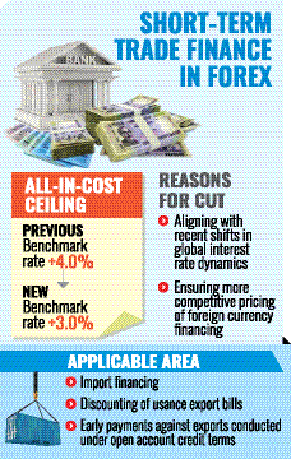
The Bangladesh Bank (BB) has lowered the all-in-cost ceiling on short-term trade finance to the benchmark rate plus 3.0 per cent from 4.0 per cent, aiming to bring borrowing costs in line with global market trends.
Under the revised rule, the borrowing cost for short-term permissible trade finance in foreign currencies will be capped at a maximum of 3.0 per cent per annum over benchmark rates, including SOFR and Euribor, depending on the currency involved, according to a BB notification issued on Monday.
The decision reflects recent shifts in global interest rate dynamics and is intended to ensure a more competitive pricing of foreign currency financing for importers and exporters, officials say.
"The new ceiling is not limited to import financing alone. It will also apply to the discounting of usance export bills and early payments against exports conducted under open account credit terms, as outlined in previous foreign exchange circulars," a senior central bank official explains.
Market insiders believe this reduction is a positive step for trade facilitation, particularly for exporters who rely on short-term financing to manage working capital.
By lowering the permissible cost ceiling, the policy is expected to ease financing burdens while maintaining consistency with international benchmarks, they say.
On the other hand, the central bank has allowed banks to facilitate remittances for visa bonds and refundable security deposits required by foreign embassies, high commissions, and other competent authorities as part of visa processing.
All authorised dealer (AD) banks are now allowed to remit funds on behalf of individual visa applicants where a visa bond or refundable security deposit is mandatory for obtaining a visa, according to another central bank notification issued on the same day.
"We have taken the latest measure to ease difficulties faced by Bangladeshi travellers during overseas visa applications," another central banker says.
As per the notification, the AD banks may also issue international or virtual cards in the applicant's name, preloaded with the required amount of bond or security deposit.
The existing international cardholders under travel entitlement facilities may also have their cards reloaded for the same purpose, provided the funds are used solely for visa-related requirements, it adds.
The facility will be applicable against balances maintained in Exporters' Retention Quota (ERQ) accounts, Resident Foreign Currency Deposit (RFCD) accounts, or through international cards issued against such accounts, subject to the existing foreign exchange regulations.
Bankers and industry insiders believe the new policy will simplify visa processing for Bangladeshi applicants, particularly for the US which requires financial guarantees as part of visa procedures.
siddique.islam@gmail.com
© 2026 - All Rights with The Financial Express

