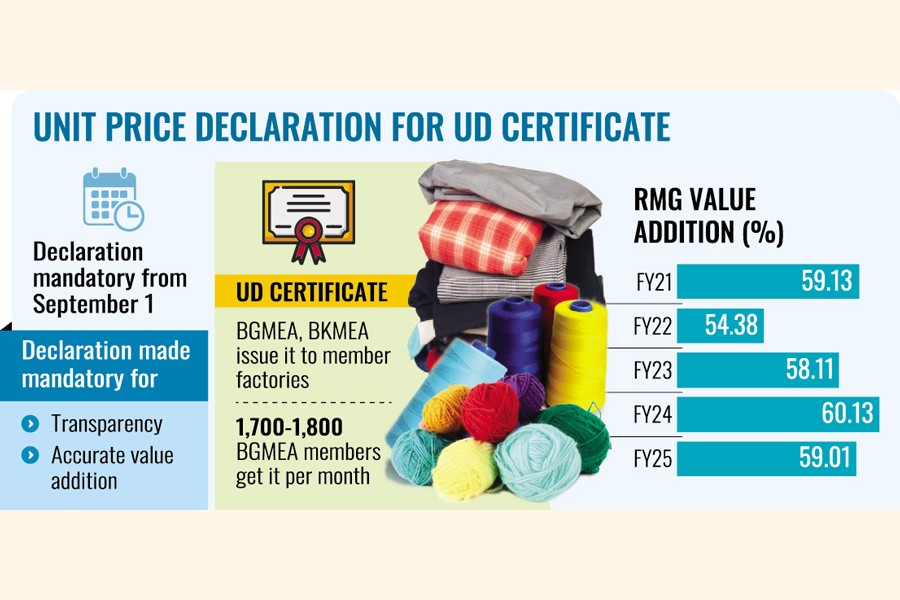
Bangladesh Garment Manufacturers and Exporters Association (BGMEA) -- the apparel apex body -- has tagged new requirements mandating factories to provide the unit price of imported raw materials and readymade garments produced for export to get utilization declaration (UD) certificates aiming to ensure transparency and accurate valuation in the industry.
In a circular issued on Sunday, BGMEA instructed its member factories to include the information to receive the UD certificates from the trade body from September 01.
"To sustain the competitiveness of the locally produced exportable garment items in the international market and to maintain the trust of foreign buyers, it is essential to accurately declare the unit price of imported raw materials and the corresponding exportable garments produced in BGMEA member factories," read the circular.
Questions have been raised by both global buyers and local regulators, especially by the National Board of Revenue, about transparency and accurate value addition by the industry in the absence of unit price, according to the notice.
In this connection, necessary measures have been taken to properly mention the unit price through specific fields while applying for UD certificates, it said.
A UD certificate is a key customs document authorising the use of duty-free imported raw materials for manufacturing export-oriented garments. It is required for customs clearance, export processes and trade preferences and cash incentives.
Both BGMEA and the Bangladesh Knitwear Manufacturers and Exporters Association (BKMEA) issue UD certificates to their members against each work order, detailing exporter, importer and raw material information.
According to BGMEA, some 1700 to 1800 member factories receive UD certificates from the trade body each month against each of their work orders.
When asked, BGMEA President Mahmud Hasan Khan said that this was the first time they would collect unit price of garments while providing UD service to its members.
"This is mainly to understand the exact level of retention or value addition in the sector," he said, adding that they would regularly collect the data and prepare monthly reports accordingly.
Mahmud Hasan, also managing director of Rising Group, said currently they didn't have any specific data on how much value was added to a garment produced in Bangladesh and exported to the global market.
Once such data was available, they would be able to guide the BGMEA members on what kind of products they would need to produce to add more value or fetch high price, he said. "And then, we will recommend our members to focus on value addition instead of volume-based production."
Meantime, value addition to Bangladesh's RMG that has fluctuated in recent years has yet to return to the pre-pandemic level, as rising cost of raw-material imports erode export gains.
Exporters mainly blame the rise in raw-material imports especially that of yarn and fabric for such subdued returns, while prices of locally made garments have also declined in recent years.
Local RMG items' value addition remained almost static between 60 per cent and 64 per cent since fiscal year (FY) 2012-13 until FY2018-19, according to Bangladesh Bank data.
But a data analysis shows a fluctuating trend, with a decline to 56.49 per cent in FY20 while a rise up to 59.13 per cent in FY21. The rate again dipped to 54.38 per cent in FY22 while rose to 58.11 per cent and 60.13 per cent in FY23 and FY24 respectively.
In FY25, Bangladesh earned US$39.34 billion from apparel exports-US$ 21.15 billion from knitwear and US$18.18 billion from woven items-while it imported raw materials worth $16.12 billion.
Thus, the country's net value of RMG exports stood at $23.21 billion in the last fiscal, showing a 59.01 per cent value addition. It was lower than 64.32 per cent in the pre-pandemic level in FY19.
The central bank considered the main head value of the components (raw cotton, synthetic/viscose fibre, synthetic/mixed yarn, cotton yarn, textile fabrics, and accessories for garments) instead of only raw materials imported under back-to-back LCs, according to its latest quarterly report.
Industry insiders say that Bangladesh is largely dependent on imported raw materials for woven garments while a majority of raw materials for knitted items are sourced from local market. Due to internal issues like gas crisis, and a cut in cash incentive for using local raw materials, import of yarn and fabric have risen in recent times, they say. According to Bangladesh Textile Mills Association (BTMA), knit fabric imports increased by 32.18 per cent to 0.51 million tonnes in the last fiscal year which was 0.38 million tonnes in FY 2023-24. Besides, 0.62 million tonnes of woven fabrics were imported in the fiscal 2024-25 which was 16.12 per cent higher than the import of 0.54 million tonnes in 2023-24.
On the other hand, yarn imports rose 13.35 per cent to 1.24 million tonnes in the fiscal 2024-25 from 1.1 million tonnes in 2023-24, according to data.
Bangladesh imported 8.35 million bales of cotton in the last fiscal compared to 7.75 million bales in the previous fiscal, BTMA data showed.
Munni_fe@yahoo.com
© 2026 - All Rights with The Financial Express

