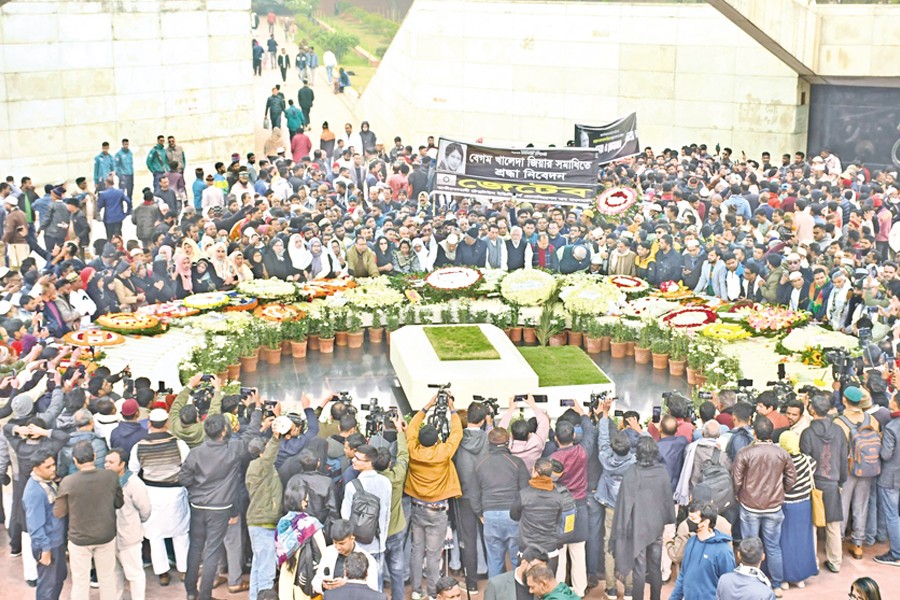
 BNP leaders and activists pay floral tributes at the grave of BNP chairperson Khaleda Zia at Zia Udyan in the capital on Friday. — FE Photo
 The Bangladesh Nationalist Party (BNP) on Friday organised milad and doa mahfil programmes in Dhaka and across the country, seeking eternal peace (maghfirat) for the departed soul of its chairperson and former prime minister Begum Khaleda Zia, marking a solemn day of remembrance for one of Bangladesh's most influential political figures.
Special doa and milad was arranged in every mosque of the country after the Jummah prayer.
A milad was held at the National Mosque Baitul Mokarram after the Jummah prayer.
A milad and doa mahfil was held after Asr prayers at the Azad Mosque in Gulshan.
Senior party leaders, including BNP acting chairman Tarique Rahman, Secretary General Mirza Fakhrul Islam Alamgir, members of the party's standing committee, and leaders of the Dhaka Metropolitan BNP and its affiliated organisations, attended the programme and offered prayers for the late leader's eternal peace.
Another milad and doa mahfil was arranged after Asr prayers at the Shahjahanpur residence of BNP standing committee member Mirza Abbas.
Party leaders said the multiple prayer gatherings reflected the deep emotional connection between Khaleda Zia and BNP leaders, activists and supporters across generations.
The BNP's student wing, Jatiyatabadi Chhatra Dal, also organised a doa and monajat programme at 5:00 pm at the Teacher-Student Centre (TSC) of Dhaka University on the same day.
Leaders of Chhatra Dal said the programme was aimed at allowing young supporters to pay tribute to Khaleda Zia, whom they described as a symbol of democratic resistance and political courage.
Beyond the capital, BNP units across the country arranged similar prayer programmes at district, upazila and ward levels.
Begum Khaleda Zia, Bangladesh's first woman prime minister and a three-time premier, passed away on December 30, 2025, at the age of 80 after a prolonged illness.
Khaleda Zia rose to national prominence after the assassination of her husband, Shaheed President Ziaur Rahman, in 1981, eventually leading the Bangladesh Nationalist Party.
She served as prime minister in 1991-1996 and again in 2001-2006, becoming the second woman to head a government in a Muslim-majority country.
Her regimes are widely credited with restoring parliamentary democracy after years of military and semi-military rule, while her political legacy also includes strong advocacy for multiparty democracy and constitutional governance.
Her later years, however, were marked by prolonged political persecution, imprisonment, and serious health complications followed by the Awami League led fascist rule.
Khaleda Zia spent several years in jail following false cases filed during the Awami League government.
After being released and later acquitted in 2025, she travelled abroad for medical treatment but continued to suffer from multiple chronic illnesses, including liver, heart and respiratory complications, before her eventual death.
BNP leaders attending Friday's prayer programmes said Khaleda Zia devoted her entire life to the cause of democracy and national sovereignty.
Speaking to reporters, party leaders recalled her role in the 1990 mass uprising that led to the fall of military ruler HM Ershad and her firm stance against Hasina's fascist rule throughout her later political career.
The death of Khaleda Zia triggered a wave of national mourning, with a 10 million crowd attending her funeral on Wednesday and condolence messages pouring in from political parties, civil society figures and international leaders.
tonmoy.wardad@gmail.com
© 2026 - All Rights with The Financial Express

