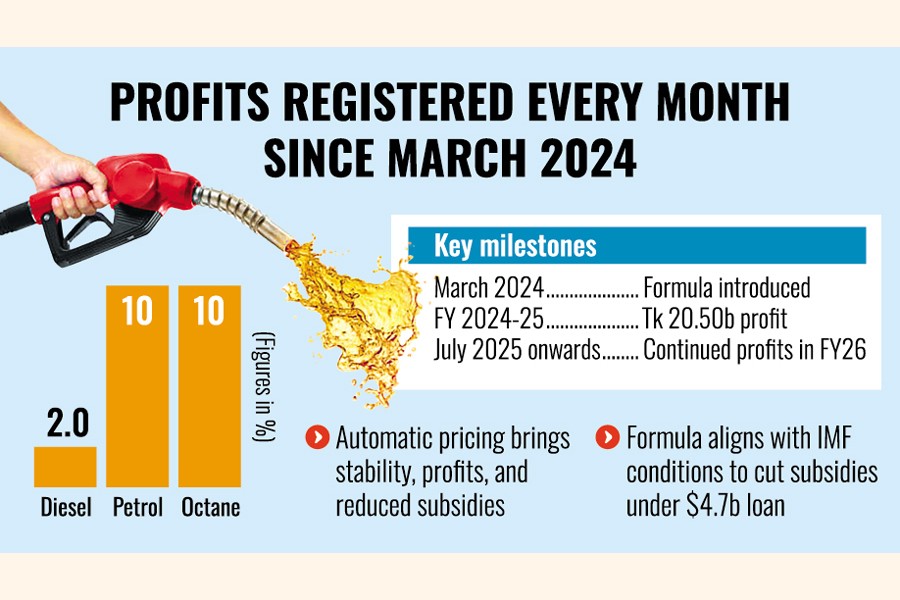
Bangladesh Petroleum Corporation (BPC) has reported consistent monthly profits since the introduction of the automatic fuel pricing formula in March 2024, driven by regular price adjustments and margins on petrol, octane, and diesel sales.
State-run Bangladesh Petroleum Corporation (BPC) has been making profits every month since the introduction of the automatic fuel pricing formula last year.
"We are making profit as petroleum products are being sold at higher rates than the cost prices," BPC Chairman Md Amin Ul Ahsan told The Financial Express on Saturday.
He said the corporation has been consistently profitable since March 2024, when the government first introduced the automated pricing system.
BPC currently earns up to 2.0 per cent profit on diesel sales and as much as 10 per cent on octane and petrol sales, Mr Ahsan added.
Benefiting from regular adjustments under the new mechanism, BPC recorded profits of around Tk 20.50 billion in the fiscal year 2024-25, according to Ministry of Finance data.
The chairman also confirmed that BPC has continued to post profits during the first two and a half months of the current fiscal year (FY 2025-26), though he did not disclose the amount.
In its latest adjustment, the government kept fuel prices unchanged in August, maintaining July levels at Tk 102 per litre for diesel, Tk 114 for kerosene, Tk 118 for petrol and Tk 122 for octane.
The Energy and Mineral Resources Division (EMRD), under the Ministry of Power, Energy and Mineral Resources (MPEMR), said prices were left steady to ensure reasonable rates and stable supply.
The automatic pricing formula was introduced on March 7, 2024.
"We have raised the price of kerosene above diesel in recent months following reports of kerosene being mixed with octane and petrol," the BPC chairman said.
Currently, kerosene is priced 11.76 per cent higher than diesel. "After increasing kerosene prices, the alleged fuel adulteration has stopped," Mr Ahsan noted.
When setting prices for refined oil products, the government typically relies on Platts oil product assessments, while crude oil prices are benchmarked against S&P Global Platts' Dated Brent.
In February 2024, BPC prepared a guideline for automatic fuel pricing under which all costs are factored in, including international prices, import duties, advance income tax and VAT, operational and administrative expenses, maintenance, BPC margins, and distributor margins.
The guideline specifies that octane and petrol, considered luxury fuels, should always be priced at least Tk 10 per litre higher than diesel in the domestic market.
Bangladesh imports around 300,000 tonnes of octane annually to meet domestic demand. Petrol demand is largely met through production at Eastern Refinery Ltd (ERL), the country's only crude-oil refinery, and at condensate fractionation plants.
Since independence in 1971, domestic fuel prices were determined by government executive orders. BPC typically made profits from petroleum trading, paying dividends to the government after clearing debts, taxes, and VAT. When global oil prices were high and volatile, the finance ministry subsidised BPC's losses.
The automatic oil pricing formula was introduced last year in line with International Monetary Fund (IMF) recommendations. It is one of several conditions linked to reducing subsidies under a $4.7 billion loan programme agreed by the previous government.
Of this package, the IMF approved about $3.3 billion under the Extended Credit Facility (ECF) and the Extended Fund Facility (EFF), and around $1.4 billion under the Resilience and Sustainability Facility (RSF).
Azizjst@yahoo.com
© 2026 - All Rights with The Financial Express

