Bangladesh's renewable-energy incentives are failing to reach the majority of consumers and businesses they were expected to benefit, according to the Bangladesh Sustainable and Renewable Energy Association (BSREA).
It says households, farmers, small commercial users and thousands of solar-sector firms have been left outside the scope of the new budget measures.
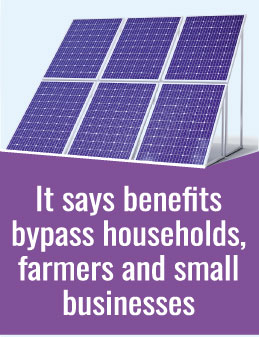 Despite widespread optimism following the announcement of tax and duty incentives for the renewable energy sector in the FY2026-27 national budget, the benefits have, in practice, been restricted to a limited number of entities, according to BSREA.
The association raised the issues at a press conference at the Dhaka Reporters Unity (DRU) in the capital on Sunday, analysing the Statutory Regulatory Orders (SROs) issued by the National Board of Revenue (NBR) immediately after the budget.
The analysis, it says, showed that the incentives largely apply only to certain solar power generation companies and providers operating under the Renewable Energy Service Company (RESCO) model through power purchase agreements (PPAs).
As a result, a large segment of solar energy users-including residential consumers, agricultural users involved in solar irrigation, small commercial enterprises and many businesses operating across the renewable energy value chain-are being excluded from the benefits.
"Renewable energy is not a special privilege for any particular business group; it is directly linked to the energy security of every citizen," BSREA President Mostafa Al Mahmood told the press conference.
"Therefore, the incentive framework must be equally accessible to all."
BSREA said the country's renewable energy market has been built largely by importers, distributors, dealers, retailers, engineering, procurement and construction (EPC) firms, and self-financed solar users.
However, the current incentive structure offers little meaningful support to these stakeholders.
According to the association, while RESCO companies have benefited under the current SRO framework, thousands of importers, dealers, retailers and EPC firms involved in the renewable energy sector face the risk of business losses and job cuts.
The organisation noted that the existing SRO framework mainly targets consumers accounting for only around 20-22 per cent of total electricity consumption, leaving a much larger group of users outside its coverage.
BSREA further argued that although the RESCO model may be suitable for large industrial consumers, it is far less effective for residential users, solar irrigation projects and rural consumers.
As a result, the majority of potential renewable energy users remain outside the government's incentive framework.
The association also said a public perception has emerged that customs duties on solar panels and related equipment have been fully withdrawn and that prices have fallen significantly.
In reality, however, there has been little change in the tax and duty structure applicable to most solar products, it said.
According to BSREA, this has created confusion in the market and placed unnecessary pressure on businesses.
The association further alleged that the current budget and related SROs do not provide effective new incentives for solar irrigation, solar street lighting or battery energy storage systems (BESS).
Despite the existence of around 1.7 million diesel-powered irrigation pumps across the country, there is no clear roadmap or financial incentive package to support their conversion to solar energy, it said.
BSREA also noted that no effective initiative has been taken to replace the long-standing weight-based assessment system for renewable energy equipment imports with the internationally recognised transaction-value method.
As a result, project costs are often inflated because imported equipment is valued above actual purchase prices, the organisation claimed.
Concerns were also raised over the decision to limit tax and duty incentives for mounting structures, lithium cells, battery packs and BESS until June 30, 2028.
BSREA argued that domestic manufacturing capacity for these products remains underdeveloped and that prematurely withdrawing incentives could discourage investment and slow market expansion.
According to the association's assessment, residential consumers, agricultural users and small commercial customers account for around 63 per cent of the country's total electricity users.
However, the current incentive framework does not provide direct benefits to these groups.
The organisation also said that critical issues such as access to low-interest long-term financing, payment security, risk mitigation and investment protection in the renewable energy sector have not been adequately addressed in the budget.
BSREA warned that achieving the government's renewable energy targets under the current framework would be difficult.
It estimated that only 2,000-3,000 MWp of solar capacity could be installed by 2030 under the existing SRO regime, far below national ambitions.
By contrast, the association argued that revising the SRO to provide zero-duty and zero-tax benefits for all importers, EPC firms, distributors and other stakeholders could help Bangladesh achieve between 6,000 MWp and 8,000 MWp of solar capacity by 2030, using just 25 per cent of rooftop space in Dhaka and the divisional cities.
BSREA also called for equal duty benefits for all renewable energy equipment, including solar modules, inverters, battery storage systems, mounting structures, DC cables, connectors and smart meters.
The association further demanded at least a 10-year tax holiday and income tax exemption, extension of incentives to residential and solar irrigation users, and the declaration of solar irrigation, solar home systems, rooftop solar and BESS as national priority sectors.
BSREA leaders, including Senior Vice-President Jahidul Alam, Vice-President M A Taher, Vice-President Engineer Md Ruhul Amin, General Secretary Md Ataur Rahman Sarkar Rozel and Director (Finance) Nitai Pad Saha, were present at the press conference.
sajibur@gmail.com
© 2026 - All Rights with The Financial Express

