Speakers at the Bangladesh-China Business Summit-2026 on Saturday called for stronger financial guarantees, timely banking settlements and deeper cooperation in renewable energy and technology-driven investment to further strengthen bilateral trade and investment ties between Bangladesh and China.
They also highlighted Bangladesh's growing potential in clean energy, manufacturing, healthcare, skills development and export diversification, while urging stronger policy support, business confidence and long-term partnerships to attract more Chinese investment.
Organised by the Bangladesh China Club Limited at the Crowne Plaza Dhaka Gulshan, the summit brought together policymakers, bankers, investors, industrialists and delegates from both countries to discuss cooperation in trade, infrastructure, healthcare, renewable energy and investment.
Speaking as the chief guest, Muzaffar Ahmed, chairman of the Sustainable and Renewable Energy Development Authority (SREDA), said Bangladesh was moving steadily towards becoming a smart, sustainable and investment-friendly nation.
He said the country's power and energy sector offered significant opportunities for international investors, particularly in renewable energy projects, rooftop solar systems, wind energy, smart grids, electric vehicle infrastructure, green hydrogen, energy storage systems and battery technology.
The SREDA chairman said Bangladesh had already introduced investor-friendly policies and long-term energy plans to support foreign investors through joint ventures, public-private partnerships and technology collaboration.
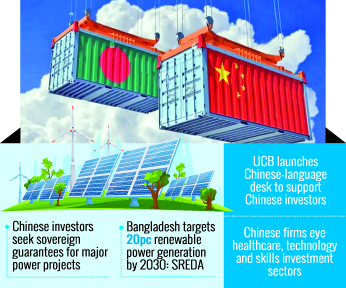
Inviting Chinese investors to explore Bangladesh as a strategic investment destination, he said the country aims to generate at least 20 per cent of its electricity from renewable sources by 2030 and 30 per cent by 2040 under the Renewable Energy Policy 2025.
He also noted that SREDA was working on rooftop solar power, net metering, solar irrigation, renewable energy data management, energy efficiency and capacity-building initiatives to support sustainable infrastructure development.
Mohammad Mamdudur Rashid, managing director and chief executive officer of United Commercial Bank PLC, said the bank had remained a long-standing partner of the Chinese business community in Bangladesh.
He said Bangladesh-China relations, established through diplomatic ties in 1975, had evolved into a strong economic and development partnership over the decades.
Highlighting UCB's 42-year journey, he said the bank had been supporting trade, entrepreneurship and foreign investment, while positioning itself as a facilitator of trade finance and foreign direct investment.
He also mentioned the bank's dedicated Chinese-language desk aimed at strengthening communication and engagement with Chinese investors and business partners.
A Mannan Khan, chairman of Mango Telecom, expressed concern over the withdrawal of sovereign guarantees in Bangladesh's power sector, warning that the move could discourage Chinese investors from participating in major projects.
"The Chinese people are asking for sovereign guarantees, otherwise they cannot participate," he said, noting that many projects involved financing from Chinese banks and state-backed institutions.
He also stressed the need for timely Letter of Credit (LC) payments to maintain investor confidence and protect the reputation of Bangladesh's banking sector.
Chairman of Hainan Meixin Grand Health Management Co. Ltd. Li Xiang announced the launch of advanced cell and gene technologies in Bangladesh aimed at regenerative medicine and tumour treatment. She said the company planned to establish international-standard anti-ageing and tumour treatment centres in partnership with local stakeholders.
"We are here to build a sustainable high medical ecosystem," she said.
Li WenGang, chairman of the Global Chinese General Chamber of Commerce, outlined plans to support Bangladeshi youth through vocational training and Chinese language education.
He said the proposed training system would include drone operation, livestreaming and computing skills to improve employability and industrial connectivity.
"The Chinese language is the key for young people to change their destiny and embrace opportunities," he added. Chen Yingjie, chairman of Guangzhou Wanxi Investment and Development Co. Ltd., focused on industrial cooperation and real estate development.
He pledged support for Bangladeshi exporters by offering exhibition opportunities in Guangzhou to help local businesses access the Chinese market and connect directly with manufacturers and investors.
Vice-president of Bangladesh China Club Limited A Hafiz delivered a presentation on investment opportunities, while the organisation's president Shajahan Bhuiyan Razu gave the welcome address.
Joint Secretary of the Ministry of Commerce and chief executive officer of the Bangladesh Foreign Trade Institute Dr Saif Uddin Ahmed said Bangladesh's graduation from the least developed country category and the possible extension of the transition period until 2029 created significant opportunities for foreign investment.
He said Bangladesh continued to enjoy duty-free and quota-free access to major global markets, making the country an attractive destination for Chinese investors seeking export-oriented manufacturing opportunities.
bdsmile@gmail.com, sajibur@gmail.com
© 2026 - All Rights with The Financial Express

