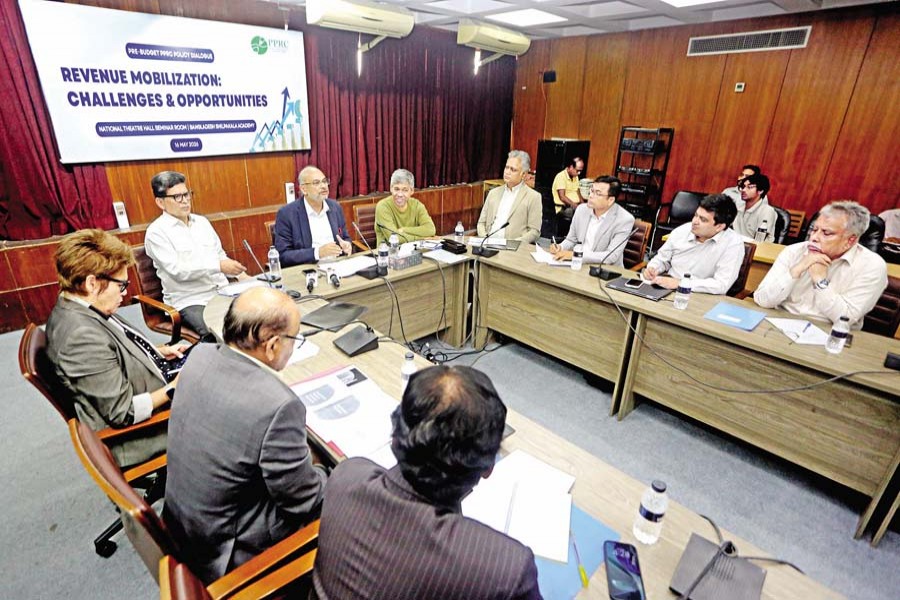
 Economists and business leaders attend a pre-budget dialogue titled "Revenue Mobilization: Challenges & Opportunities", organised by the Power and Participation Research Centre in the capital on Saturday. Prime Minister's Adviser on Finance and Planning Dr Rashed Al Mahmud Titumir was present as the chief guest.— FE Photo by K Asad-Uz-Zaman
 Business leaders on Saturday alleged that businesses in Bangladesh are living under a kind of "tax terrorism", saying fear of harassment and lack of transparency in public spending discourage people from paying taxes.
They called for comprehensive reforms to create a transparent, predictable and fear-free tax environment and urged the government to broaden the tax base instead of repeatedly increasing the burden on compliant taxpayers.
The observations came at a pre-budget dialogue titled "Revenue Mobilization: Challenges and Opportunities", organised by the Power and Participation Research Centre (PPRC) in the capital.
Speaking as the chief guest, Dr Rashed Al Mahmud Titumir, adviser to the prime minister on finance and planning, said the government plans to increase revenue in the next fiscal year without raising tax rates.
Dr Abdur Rahman Khan, chairman of the National Board of Revenue, also attended the event as special guest, while the session was chaired by Hossain Zillur Rahman, executive chairman of PPRC.
Economists and private-sector representatives stressed the need for credible tax reforms, reduced dependence on indirect taxes and stronger accountability in the revenue system to boost investment, employment and economic growth.
Dr Titumir said Bangladesh's low revenue collection is driven largely by political economy constraints rather than technical issues alone, as many tax reforms fail to address deeper structural problems.
He acknowledged that weak tax compliance is linked to harassment, lack of transparency and poor public service delivery, adding that people are discouraged from paying taxes when they do not see visible improvements in public services.
He said the government is focusing on digitisation, cashless transactions, risk-based auditing and reforms in customs procedures and HS code management to improve revenue collection.
"The government aims to raise revenue without increasing tax rates by improving efficiency and domestic resource mobilisation," he added.
Presenting a keynote paper, Hossain Zillur Rahman identified three major challenges in Bangladesh's revenue system -- underperformance, tax evasion and taxpayer harassment.
He said persistent revenue shortfalls reflect structural weaknesses, including a narrow tax base, extensive tax exemptions and ad hoc enforcement practices.
He also pointed to weak institutional reform momentum and inefficiencies in public spending that continue to constrain investment and revenue growth.
NBR Chairman Dr Abdur Rahman Khan said harassment remains the most widely discussed issue in the tax system.
He said the only effective solution is a fully faceless tax administration that would allow compliant taxpayers to fulfil obligations from home without physical interaction with tax officials.
According to him, the NBR has already introduced several mechanisms to reduce taxpayer harassment and is working to expand faceless services further.
Speaking as a panel discussant, Syed Nasim Manzur, managing director of Apex Footwear, said people in Bangladesh are reluctant to pay taxes mainly due to fear and concerns over whether tax revenues are spent transparently.
"Unfortunately, we are living under a kind of tax terrorism. We are extremely fearful that if we come under scrutiny, the same people will be forced to pay even more taxes. This culture of fear has to be broken," he said.
Dr Zaidi Sattar, chairman of the Policy Research Institute, said Bangladesh's tax system remains outdated and requires radical reform.
He noted that the last major tax reform was undertaken in 1991 and called for expanding the narrow tax base, digitising tax administration and reducing dependence on complex trade taxes.
Gayle Martin, operations manager of the World Bank Dhaka office, said tax and revenue reforms are crucial for maintaining macroeconomic stability.
She said slowing economic growth, fiscal pressure and rising public debt are exposing structural vulnerabilities, while low tax-to-GDP ratios are forcing cuts in health and education spending.
She also stressed the need to modernise and simplify the VAT system, warning that extensive exemptions are reducing revenue and weakening equity.
Dr Md Nurul Amin said annual residential and commercial house rent transactions exceed Tk 2.05 trillion, from which around Tk 205.27 billion could be collected at a 10 per cent tax rate.
However, he said only Tk 13.98 billion is currently being collected because many property owners either do not have TINs, fail to submit tax returns or underreport rental income.
Simeen Rahman, chief executive officer of Transcom Group, questioned the level of tax and VAT compliance in the country, saying many taxpayers are not fully complying with existing obligations.
She said weak monitoring and enforcement are causing significant revenue leakage, while compliant businesses are becoming less competitive than non-compliant ones.
She also suggested that Bangladesh should learn from countries that have already introduced sugar taxes if the government considers implementing such a measure in future.
jahid.rn@gmail.com
© 2026 - All Rights with The Financial Express

