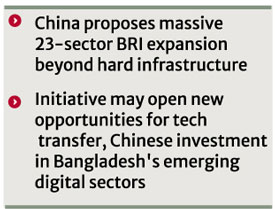
China has proposed broadening cooperation with Bangladesh under the Belt and Road Initiative (BRI) beyond traditional infrastructure development to include trade and investment, energy, digital economy and innovation, green development, health and medicine, maritime cooperation, and natural disaster prevention.
The National Development and Reform Commission (NDRC) of China has submitted a cooperation plan outlining enhanced bilateral engagement across 23 specific sectors, grouped under three broad themes, ahead of Prime Minister Tarique Rahman's scheduled visit to the country later this month.
 The Bangladesh embassy in Beijing recently forwarded to Dhaka a Chinese draft titled "Cooperation Plan on Jointly Promoting the Belt and Road Initiative between Bangladesh and China," which Beijing expects to be signed during the prime minister's visit.
The draft has been proposed in light of the Memorandum of Understanding signed between Bangladesh and China under the BRI framework during Chinese President Xi Jinping's visit to Bangladesh in 2016, according to a letter from the Bangladeshi envoy in Beijing.
The embassy also requested that rapid inter-ministerial processes would help finalise the draft from the Bangladesh side, making it ready for signing ahead of the prime minister's visit.
The draft document outlines a broader vision for BRI cooperation based on peace, openness, mutual benefit, and sustainable development, while emphasising environment-friendly, transparent, and people-centric development.
The 23 cooperation areas include economic development, trade and investment, energy, digital economy, agriculture, science and technology, education, healthcare, disaster management, and environmental protection, according to the draft.
The plan also proposes the creation of sector-specific cooperation platforms, policy support mechanisms, and coordination arrangements.
Digital economy cooperation has received particular emphasis in the proposed framework, while it proposes Bangladesh's inclusion in the "Belt and Road International Digital Economy Cooperation Initiative" and suggests the formation of a joint director-general-level working group on digital economy cooperation.
The framework also envisages enhanced collaboration in cloud computing, data management, technological innovation, and digital infrastructure development.
"Earlier, the initiative was largely focused on roads, bridges, ports, and power plants. Now digital connectivity, data economy, and technology-driven growth are becoming equally important," says a Dhaka-based policy analyst.
They believe the initiative could open new opportunities for technology transfer and Chinese investment in Bangladesh's emerging digital sectors.
Although the Teesta issue is not directly mentioned in the draft document, issues related to water resources, regional development, and infrastructure cooperation have been included, fuelling speculation that separate discussions or announcements regarding the Teesta project may emerge during the visit.
China proposed that Bangladesh increase its participation in major Chinese trade fairs and exhibitions, including the China International Import Expo, China Import and Export Fair, and China-South Asia Exposition.
Officials believe greater participation could create new market opportunities for Bangladeshi products in China.
The draft also highlights cross-border e-commerce cooperation and proposes regular international forums to strengthen digital trade ties.
China views digital commerce as a major future growth driver and considers Bangladesh an important partner in that process, sources say.
Bangladesh has been invited to join the "Belt and Road Green Development Initiative," while the plan proposes new coordination mechanisms on pollution control, environmental protection, and low-carbon development.
In education and research, the proposal includes regular Chinese-language education forums in Bangladesh, increased exchanges among researchers and academics, and expanded think tank dialogue.
Strengthening activities of China research centres in Bangladesh has also been discussed.
The framework further proposes cooperation in medical technology, healthcare management, public health and pharmaceuticals, reflecting growing emphasis on health security in the post-pandemic period.
New initiatives have also been proposed in maritime cooperation, agriculture, energy, and disaster management.
The document mentions regular dialogue on Bay of Bengal-centred blue economy cooperation, marine resource management, and regional connectivity.
jahid.rn@gmail.com
© 2026 - All Rights with The Financial Express

