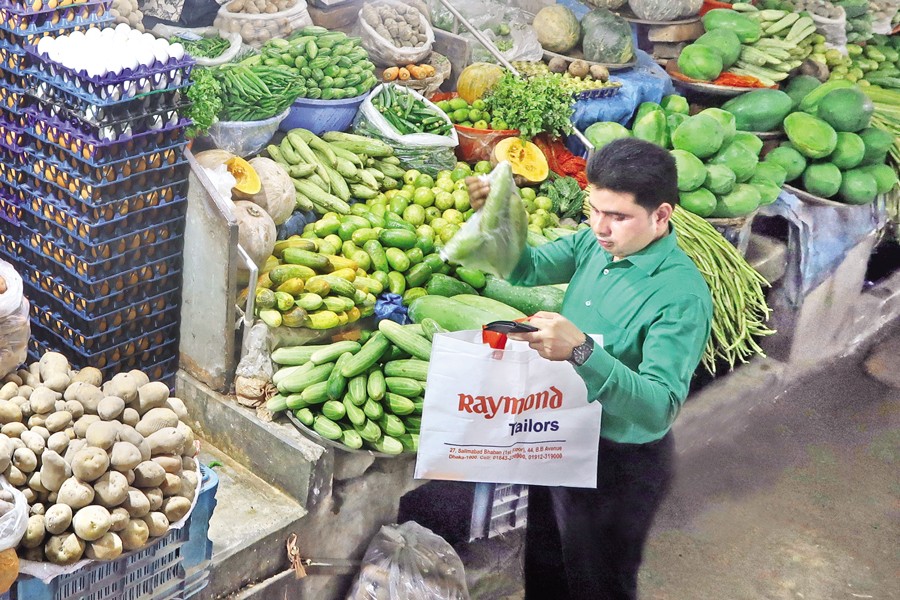
 A consumer packs vegetables after purchase at a city kitchen market on Thursday. The prices of almost all essentials have surged in recent weeks. — FE Photo
 Prices of essential commodities have surged over the last week, adding to the financial strain of ordinary consumers already grappling with high costs.
Vegetables, flour, edible oils, and chicken all recorded price hikes. Most vegetables now trade at Tk 80-120 per kg, while some are available at Tk 60-80 per kg.
Brinjal sells at Tk 90-120, snake gourd at Tk 80-90, and pointed gourd at Tk 70-80 per kg. Only green papaya remains relatively affordable at Tk 40-50 per kg.
Potatoes remained steady at Tk 25-30 per kg, but green chilli saw a steep jump, hitting Tk 350-400 per kg -- up Tk 100-140 in just a week.
Ramjan Ali, a vegetable trader at Rayer Bazar, said heavy rains damaged crops in several districts, while farmers have begun planting early winter vegetables. "Vegetable prices are likely to remain high until November, as August-October is a transitional period," he noted.
The Trading Corporation of Bangladesh (TCB) reported that loose soybean oil prices rose another 5-6 per cent. Flour prices increased by Tk 5 per kg in both loose and packet forms, according to grocers.
The onion market remains unstable despite the arrival of over 5,000 tonnes of imported onions in a week. Local onions are trading at Tk 80-90 per kg depending on quality.
Azhar Islam, an onion and spice trader at Karwan Bazar in the capital, said district-level prices fell by Tk 5-6 per kg following imports, and he expects retail prices in Dhaka to drop soon.
SM Nazer Hossain, vice-president of the Consumers Association of Bangladesh (CAB), said the rise in soybean oil prices reflects weak government intervention.
"Prices of fish, meat, and vegetables have surged sharply, causing severe hardship for ordinary people," he added.
TM Rashed Khan, assistant director of the Department of Agricultural Marketing (DAM), noted that daily onion demand exceeds 9,000 tonnes.
"Importing 1,500-2,000 tonnes per day could reduce prices by 20-25 per cent in the coming weeks, taking advantage of lower prices in India, Pakistan, and other exporting countries."
tonmoy.wardad@gmail.com
© 2026 - All Rights with The Financial Express

