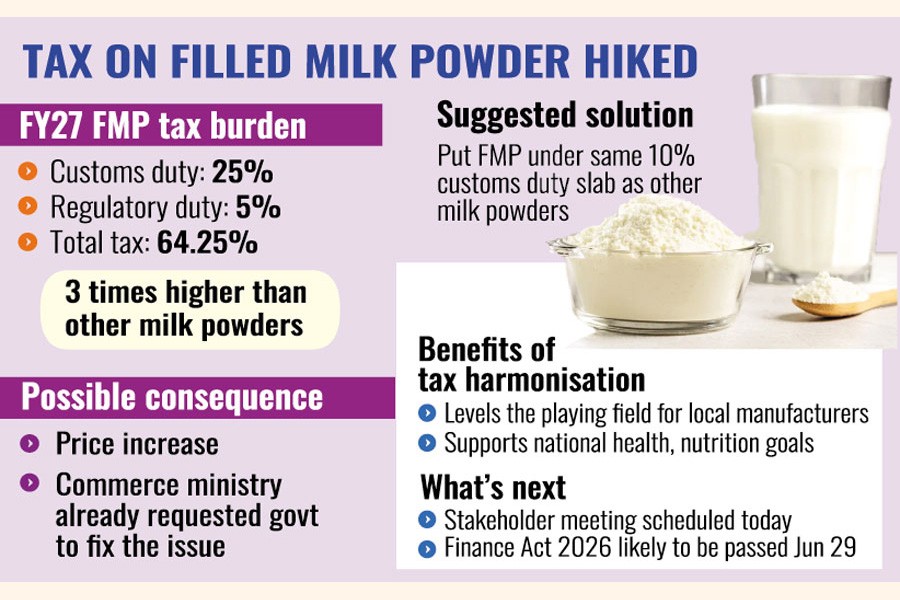
The government's decision to reduce customs duty on bulk infant formula may not bring meaningful relief to consumers as the country's most widely consumed milk- powder category -- filled milk powder (FMP) -- has been subjected to higher taxation in the new national budget.
While customs duty on bulk infant formula has been lowered to 10 per cent, FMP, which uses vegetable fats and enjoys the highest market penetration, has seen a tax increase.
The move has raised concerns among local industry players over a possible increase in consumer prices.
A meeting involving the relevant stakeholders is scheduled for today to discuss the issue.
A senior official of the National Board of Revenue (NBR) says the Ministry of Commerce (MoC) has already requested the government to address the structural discrepancy concerning FMP in the Finance Act 2026, which is expected to be passed on June 29.
The official acknowledges the rationale for placing FMP under the same 10 per cent customs duty tier as other milk powder categories to harmonise the tax structure and ensure a level playing field.
Under the Provisional Collection of Taxes Act 1931, the customs measures became effective on June 11, 2026, the day the finance minister presented the FY27 national budget in parliament.
Mr Anowarul Amin, head of corporate affairs, communication and sustainability at Arla Foods Bangladesh, says FMP is the only milk powder category subject to such a high level of taxation in Bangladesh.
Arla Foods is an international dairy company owned by more than 8,400 farmers across Denmark, Sweden, the UK, Germany, Belgium, Luxembourg, and the Netherlands.
"Following the recent increase in regulatory duty, the cumulative tax burden on FMP has reached approximately 64.25 per cent, which is more than three times higher than the tax incidence applicable to other milk powder categories," Mr Amin tells The Financial Express.
"This differential treatment places FMP-based manufacturing at a competitive disadvantage and appears inconsistent with the objectives of promoting value addition, industrial growth, and affordable nutrition for low-income consumers."
Following the latest changes, FMP is now subject to a 25 per cent customs duty and a 5.0 per cent regulatory duty.
According to industry estimates, FMP currently enjoys an 88 per cent household penetration rate nationwide.
Industry insiders say FMP provides protein and calcium levels that are nearly identical to those of premium whole milk powder, while remaining a more affordable option for lower-income families.
At present, fiscal policy groups FMP with sweetened condensed milk, which contains around 47 per cent refined sugar and comparatively lower protein content.
While condensed milk is subject to a higher tax slab because of its high sugar content, stakeholders argue that nutrient-rich FMP should be treated similarly to other standard milk powders that face lower duties and contribute positively to nutritional outcomes.
They also note that filled milk powder serves as a critical source of protein and micronutrients for growing children and adolescents and should not be treated as a luxury or confectionery product.
Earlier, during a meeting between the Ministry of Commerce and a European Union delegation in April, participants highlighted the importance of harmonising milk powder tariffs to strengthen bilateral trade.
Ms Nuria Lopez, chairperson of the European Chamber of Commerce in Bangladesh (EuroCham), said, "European enterprises are committed to meeting Bangladesh's nutritional needs through safe and affordable dairy products. Harmonising duties on filled milk powder will eliminate non-compliant competition, secure government revenue, and unlock vital foreign direct investment from European companies to support the development of Bangladesh's dairy sector."
"We also appreciate the government's efforts toward bringing all milk categories under a similar tax structure, making milk more accessible as a source of nutrition and supporting the Sustainable Development Goals on health," she added.
Stakeholders point out that regional countries such as Sri Lanka, Pakistan, Vietnam, and Cambodia place FMP in the same tariff category as whole milk powder.
They argue that beyond the immediate tax implications, tariff harmonisation would create a level playing field, ensure consistency in revenue collection, and encourage future investment in Bangladesh's dairy sector.
doulotakter11@gmail.com
© 2026 - All Rights with The Financial Express

