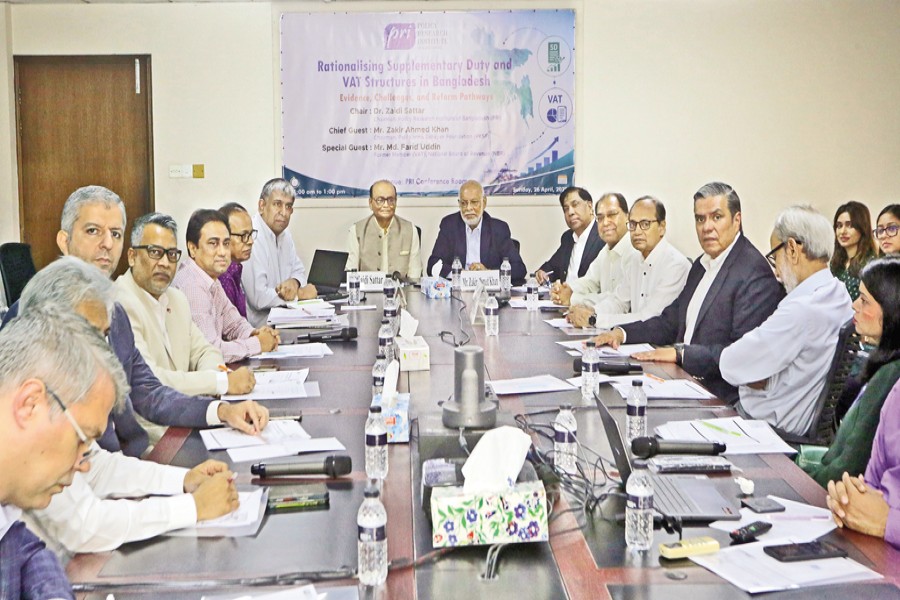
 Guests and participants pose for a photograph at a policy dialogue organised by the Policy Research Institute of Bangladesh (PRI) at the PRI conference room in the capital on Sunday. The event was chaired by PRI Chairman Dr Zaidi Sattar, while Palli Karma Sahayak Foundation Chairman Md Zakir Ahmed Khan attended as the chief guest. — FE Photo
 Bangladesh could nearly double its tax revenue without raising rates if it undertakes deep reforms in tax administration, improves compliance, and reduces systemic leakages, experts said on Sunday.
They argued that with stronger transparency, accountability and enforcement capacity, the country's tax-to-GDP ratio could rise from the current level of below 7.0 per cent to around 15 per cent.
Key recommendations include separating tax-policy formulation from tax-collection functions and modernising the VAT and supplementary duty regime to make the system more efficient and investment-friendly.
Experts made the observations at a policy dialogue titled "Rationalising Supplementary Duty and VAT in Bangladesh: Evidence, Challenges, and Reform Pathways," organised by the Policy Research Institute of Bangladesh (PRI) with support from The M Group, Inc.
Zakir Ahmed Khan, Chairman of Palli Karma-Sahayak Foundation (PKSF), attended the event as chief guest at the PRI office in the capital, chaired by Dr Zaidi Sattar, Chairman of PRI.
Speakers included Shamsul Huq Zahid, Editor of The Financial Express, and Zakir Hossain, Associate Editor of The Daily Samakal, who shared insights on the keynote paper presented by Dr Bazlul Haque Khondker, Research Director of PRI, and Hafiz Choudhury, Principal of The M Group.
Zakir Ahmed Khan feels that Bangladesh's tax potential is significantly higher if enforcement is strengthened and systemic leakages are reduced, noting that proper enforcement of existing laws alone could raise revenue by 30-40 per cent.
He estimates that the tax-to-GDP ratio could reach around 15 per cent without raising tax rates if compliance improves, while cautioning that enforcement must avoid becoming "tax terrorism" and should instead encourage voluntary compliance.
He also underscores the need to separate tax policy from administration under the National Board of Revenue (NBR) to improve efficiency, accountability and analytical capacity.
Emphasising the need for deep structural reforms, Zakir Ahmed Khan says tax-policy formulation should be separated from tax administration, stressing that the two functions cannot be effectively handled through sporadic discussions.
He also highlights an acute lack of research capacity, calling for continuous policy work alongside urgent measures to address immediate revenue shortfalls in the current and next fiscal years.
Dr Zaidi Sattar says Bangladesh's tax liberalisation reflects a structural revenue deficit and weak tax buoyancy.
He notes that heavy reliance on import tariffs, regulatory duties and supplementary duties has pushed up domestic prices, making goods more expensive than international benchmarks and eroding competitiveness despite higher purchasing-power parity estimates.
Dr Bazlul Haque Khondker said the VAT and Supplementary Duty (SD) system suffers from structural inefficiencies, weak compliance and policy unpredictability.
He cited modelling results showing annual revenue shortfalls of around Tk 589 billion, while warning that frequent rate changes create uncertainty and may discourage foreign direct investment (FDI).
He also noted that very high SD rates may have exceeded revenue-maximising levels, pushing economic activity into informal markets.
He recommended separating VAT and SD, improving data-driven tax design, strengthening compliance, and introducing sector-based pilots alongside digital and green taxation.
Hafiz Choudhury described Bangladesh's tax system as colonial-era in structure and called for modernisation through broadening the tax base, shifting towards harm-based taxation in sectors like tobacco and emerging products, eliminating tax cascading, and strengthening digital enforcement through track-and-trace systems.
Shamsul Huq Zahid said NBR's reliance on supplementary and regulatory duties reflects weaknesses in direct tax collection and inefficiencies in administration, adding that Bangladesh is lagging behind regional peers in adopting modern tax systems like GST.
He also highlighted implementation gaps in donor-funded projects and stressed the need for structural reform and simplification of tax rates.
Fariduddin Ahmed, former Member of NBR, said customs collect around Tk 150 billion annually in additional taxes, which he described as a "sanctioned advantage" rather than fair revenue.
He also noted that the supplementary duty structure, with rates ranging from 5 per cent to 500 per cent across multiple items, creates around 113 tax incidence variations and contradicts WTO principles.
Zakir Hossain criticised weak transparency in revenue data, saying the lack of sector-wise disclosure limits informed analysis and effective policy debate.
He also said pre-budget consultations are too brief and should be replaced by year-round, data-driven discussions.
Ahmet Zahit Erdem, Chief Financial Officer at Coca-Cola Beverages Bangladesh, said the company has continued increasing investment up to 2024 amid confidence in Bangladesh's food market and economic resilience.
However, he noted rising tax pressure, with minimum tax increasing fivefold, supplementary duty rising to 30 per cent from 25 per cent, and import duty on concentrate increasing from 10 per cent to 15 per cent, raising total tax incidence from around 43 per cent to 54 per cent-among the highest globally.
jahid.rn@gmail.com
© 2026 - All Rights with The Financial Express

