Enforced disappearances in Bangladesh were carried out primarily for political purposes and were part of a systemic practice rather than isolated incidents of abuses, according to the final report of the Commission of Inquiry on Enforced Disappearances.
The report, submitted to Chief Adviser Professor Muhammad Yunus on Sunday, reveals that the practice was sanctioned at the highest levels of the state, implicating senior political figures in a series of high-profile cases.
The commission said its findings point to the involvement of senior political authorities, including ousted prime minister Sheikh Hasina, her defence affairs adviser Major General (retd) Tarique Ahmed Siddique, and former home minister Asaduzzaman Khan, in a number of high-profile enforced disappearance cases.
It also cited evidence of cross-border renditions, noting that victims were transferred outside Bangladesh without any legal process -- a practice the commission said "could not have taken place without authorisation at the highest level of the state".
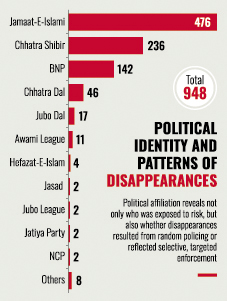
The commission members told the chief adviser that the data they examined established enforced disappearance as a politically motivated crime, rather than isolated excesses by individual officers.
"What the evidence shows is a pattern of politically driven enforcement," one member said, adding that the involvement of multiple agencies and cross-border transfers demonstrated "central coordination and approval".
"This was not random misconduct. The evidence shows a politically authorised system that functioned for years," the commission observed.
The report was formally handed over to the chief adviser at the State Guest House Jamuna by the five-member commission, led by Justice Moyeenul Islam Chowdhury.
Commission members Justice Md Farid Ahmed Shibli, Md Nur Khan, Dr Nabila Idris and Md Sazzad Hussain were present during the handover. Adviser Adilur Rahman Khan and Principal Secretary Sirajuddin Mia were also present.
According to the commission, a total of 1,913 complaints were submitted during the investigation. After eliminating 231 duplicate submissions and 113 cases that did not meet the legal definition of enforced disappearance, the commission verified 1,569 cases, accounting for around 82 per cent of all complaints received.
Of them, 1,282 victims later resurfaced, while 287 cases involved death, either through permanent disappearance or recovery of bodies after prolonged illegal detention.
Among the verified cases, 251 individuals never returned and are presumed dead, while the bodies of 36 victims were later recovered, often following alleged "crossfire" incidents or from rivers bearing gunshot wounds.
The commission noted that approximately one in six victims remains missing, leaving families without closure.
The data show that enforced disappearance overwhelmingly targeted men, with 1,546 male victims (98.5 per cent) and only 23 female victims (1.5 per cent) recorded.
However, the commission cautioned that disappearances of women are likely underreported due to stigma, fear and social pressure, leading many families to avoid filing complaints.
bdsmile@gmail.com
© 2026 - All Rights with The Financial Express

