A flagship government initiative to expand technical and vocational education across Bangladesh has stalled badly, with construction of Technical School and Colleges (TSCs) yet to begin in hundreds of upazilas despite repeated deadline extensions and sharp cost escalations.
Officials say the prolonged delays are undermining national efforts to build a skilled workforce at a time when youth unemployment and labour-market pressures are intensifying.
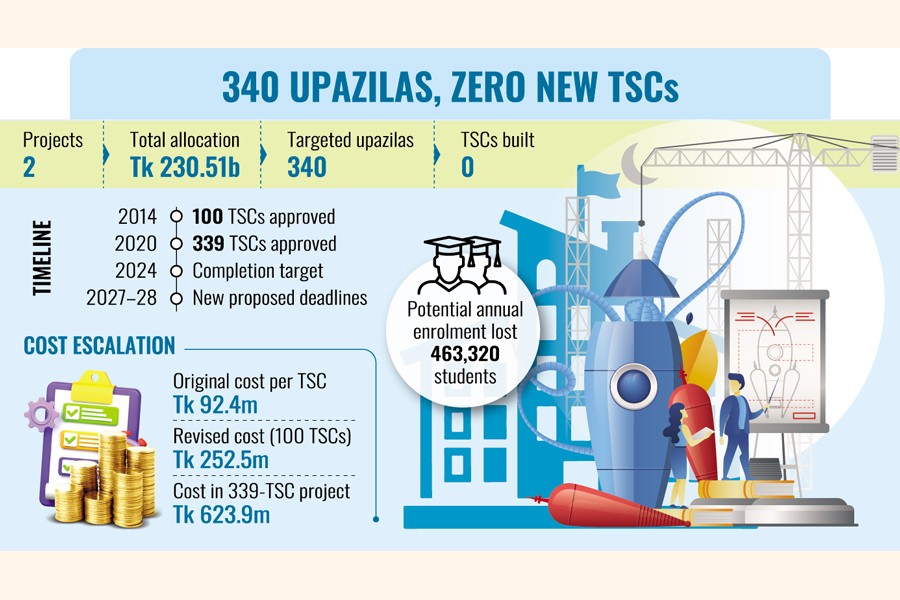
Planning Commission officials noted that timely implementation of two major projects, together valued at Tk 230.51 billion, could have enabled annual enrolment of more than 463,000 students in technical education at the secondary and higher secondary levels by 2024.
Instead, years of inaction, repeated revisions and rising costs have left the programme far behind schedule.
The setbacks have raised concerns about project management efficiency and policy credibility, particularly as successive national plans have placed skills development at the centre of Bangladesh's long-term growth strategy.
A project undertaken in 2014 to construct 100 TSCs within three years at an estimated cost of Tk 9.24 billion has already seen its deadline extended six times, with the current tenure set to expire this December.
A proposal has now been placed to further extend the project until June 2027, revising the cost to Tk 25.25 billion, around 2.73 times the original allocation.
Meanwhile, another project approved in 2020 with an estimated cost of Tk 205.26 billion to build TSCs in the remaining 339 upazilas by 2024 has made negligible progress.
So far, only Tk 1.06 billion has been spent, representing just 0.52 per cent of the total allocation, while physical progress stands at around 3.0 per cent over the past five and a half years.
Despite failing to initiate construction of a single TSC under the project, the implementing agency has proposed extending the deadline until December 2028.
If approved, the projects would take nine years to complete work originally scheduled for five years.
Project officials said implementation has been delayed mainly due to land-related complications triggered by the inclusion of several high-cost components.
These include construction of a six-storey female dormitory at each institute and excavation of a pond at every TSC, even though deep tube-wells and water supply pipelines were already included in the original designs.
Sources also alleged that repeated revisions became necessary as multiple project components were bundled together in ways that created scope for financial irregularities, further slowing implementation.
Planning Commission officials said prolonged delays and steep cost escalations have raised serious concerns over project management efficiency and policy credibility, particularly at a time when expanding skills training is considered critical to addressing youth unemployment and meeting the evolving demands of the labour market.
According to project documents, under the National Skills Development Policy 2011, the government set a target to raise the share of students in technical education at the secondary level from 3.0 per cent to 20 per cent and to increase enrolment in skills training by 50 per cent through the establishment of one TSC in each upazila.
However, more than a decade after the policy was adopted, progress on the ground remains minimal.
The Seventh Five-Year Plan, adopted in 2015, stressed the need for serious efforts to upgrade institutional capacity for delivering technical and vocational education and skills training.
The plan highlighted the project to establish 100 technical schools at the upazila level and committed to constructing 389 technical school and colleges nationwide.
Meanwhile, the Eighth Five-Year Plan, adopted in 2020, noted that enrolment in technical and vocational education and training (TVET) increased from 1.0 per cent in 2009 to 16.1 per cent in 2018, underscoring the urgency of sustaining momentum through effective project implementation.
An analysis of the proposal suggests that the original cost of the project titled "Establishment of 100 Technical School and Colleges at Upazila Level", approved in 2014, was Tk 9.24 billion - equivalent to Tk 92.4 million per institute.
Following revision, the total project cost has been raised to Tk 25.25 billion, pushing the average cost per institute to Tk 252.53 million.
In contrast, the cost of the separate project to establish 329 Technical School and Colleges has been set at Tk 205.26 billion, translating into an average of Tk 623.88 million per TSC.
As a result, the per-institute cost under the second project is about 6.75 times higher than that of the original allocation under the first project.
The proposal further reveals that construction of any TSC under the second project has yet to begin, prompting the implementing agency to seek a three-year extension of the project tenure.
Officials cautioned that overall project costs are likely to rise further once construction activities commence following land acquisition and completion of the tendering process.
The proposal also shows that the cost of constructing female hostels is to be reduced by Tk 10.96 billion, as the size of each hostel will be downsized to three storeys from six storeys in the original plan.
Another Tk 2.96 billion is expected to be saved from Liberation War monuments following downward revisions to cost estimates.
In addition, allocations for gas line installation, guard room construction, deep tube-wells, underground water reservoirs and overhead tanks will be dropped, as these works are already included under other components of the original plan.
Officials said the elimination of overlapping components would result in savings of around Tk 5.0 billion.
jahid.rn@gmail.com
© 2026 - All Rights with The Financial Express

