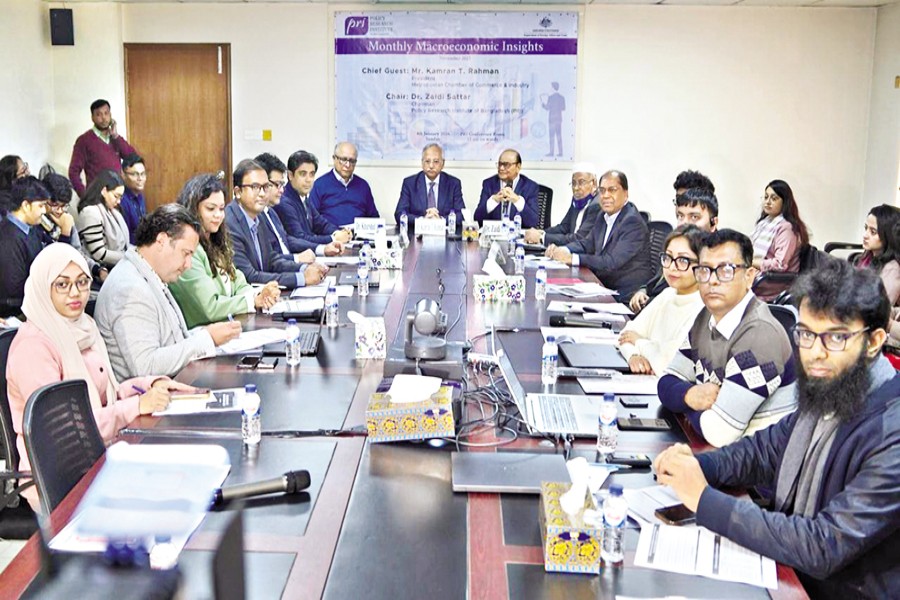
 The Policy Research Institute of Bangladesh (PRI) organised a seminar at its Dhaka office on Sunday to unveil the latest edition of its Monthly Macroeconomic Insights (MMI). Kamran T Rahman, President of the Metropolitan Chamber of Commerce and Industry (MCCI), spoke as the chief guest at the event; chaired by Dr Zaidi Sattar, Chairman of the PRI. — FE Photo Story on Page 8
 Experts warned on Sunday that while Bangladesh has achieved some level of macroeconomic stabilisation, the economy remains vulnerable to being trapped in a sub-optimal low-growth equilibrium due to weak investment, high interest rates, inflation and unemployment.
They suggested converting short-term stabilisation gains into a sustainable medium-term reform agenda and called for a focus on restoring investor confidence through political stability, institutional strengthening, financial sector reforms and improved revenue mobilisation.
The experts made the observations at a seminar organised by the Policy Research Institute of Bangladesh (PRI) at its Dhaka office. The latest edition of the Monthly Macroeconomic Insights (MMI), prepared by the PRI's Centre for Macroeconomic Analysis (CMEA), was unveiled at the event.
Kamran T. Rahman, President of the Metropolitan Chamber of Commerce and Industry (MCCI), spoke as the chief guest at the event chaired by PRI Chairman Dr Zaidi Sattar.
Dr Nasiruddin Ahmed, former chairman of the National Board of Revenue (NBR), and Ashraf Ahmed, former president of the Dhaka Chamber of Commerce and Industry (DCCI), delivered insights on the keynote paper presented by Dr Ashikur Rahman, principal economist of PRI.
Dr. Ashikur Rahman described the outgoing year as one of stabilisation, despite ongoing political uncertainty.
He noted that foreign exchange reserves have increased, the exchange rate has stabilised, and inflation has slightly moderated.
However, he warned that the economy risks becoming stuck in a cycle of lower growth, lower investment, higher inflation and higher capital cost.
Kamran T. Rahman said that Bangladesh is now in a critical juncture from the private sector perspective, as industries are struggling with a high financing cost, energy shortages and policy uncertainty.
He called for restoring political stability, strengthening institutions, fixing financial sector, improving revenue mobilisation and rebuilding confidence among investors and households.
Growth in particular remained subdued and investors remain hesitant, waiting for better environment after the national election, he said, adding that high borrowing cost, policy uncertainty and energy concerns are holding back expansion plan for many businesses.
The MCCI president stressed that the restoration of growth is not only about improving macroeconomic figures but also about ensuring that policies are predictable, well-executed, and supported by political stability.
He also pointed to Bangladesh's low tax-to-GDP ratio, one of the lowest in the region and globally, and advocated for an integrated tax system to broaden the tax base, saying that only a small proportion of TIN holders submit tax returns.
Dr. Zaidi Sattar said that Bangladesh had managed to restore macroeconomic stability despite facing severe shocks, but growth had slowed due to weak investment.
He noted that while the nominal exchange rate has remained stable at around Tk 122 per US dollar, the real effective exchange rate has appreciated by 6-7 per cent over the past four months, potentially eroding external competitiveness.
Although Bangladesh Bank is committed to a flexible exchange rate regime, its purchase of $3.3 billion in FY26 to build reserves amounts to market intervention, which partly contradicts that stance, he said, pointing to trade-offs between controlling inflation, managing import growth, and preserving export competitiveness.
Dr Sattar said Bangladesh's economy has strong inherent growth momentum of around 6 per cent, but current growth has fallen below 4 per cent due to an investment slowdown, with the investment-to-GDP ratio falling to 28-29 per cent against the 30 per cent required to sustain higher growth rates.
He also noted that while inflation, currently at 8.3 per cent, is gradually declining, the banking sector remains under stress, with high non-performing loans. Despite these challenges, the external sector has shown improvement, with the current account deficit remaining below 1 per cent of GDP and the balance of payments turning positive.
Dr Ashikur Rahman highlighted shortcomings in rice import policy, noting that domestic prices rose by double digits despite a decline in global prices.
He also pointed out that although the policy rate stands at 10 per cent, inflation remains above 8 per cent, keeping the real policy rate below 2 per cent, among the lowest in the region.
jahid.rn@gmail.com
© 2026 - All Rights with The Financial Express

