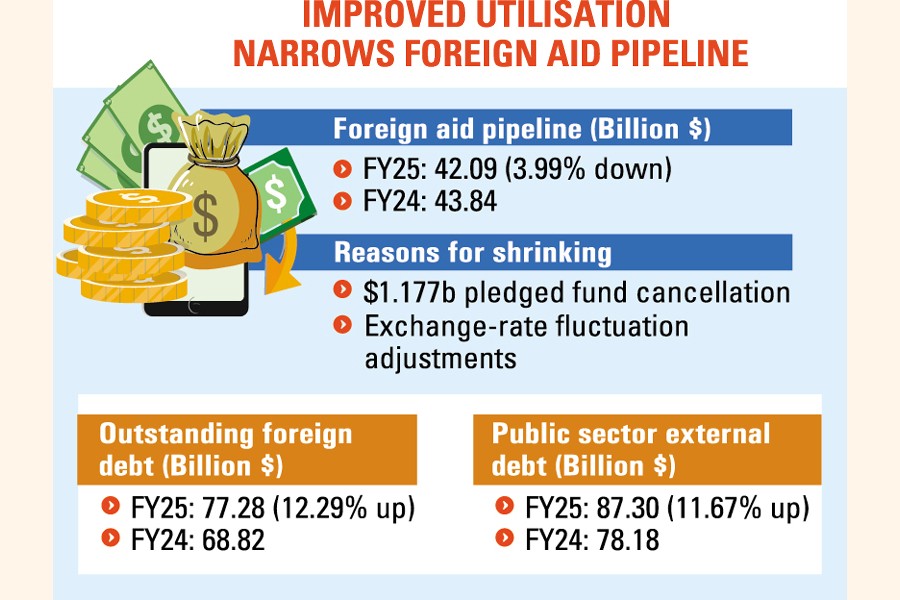
The pipeline of foreign aid - funds available for disbursement - narrowed to $42.09 billion in FY25, marking a 3.99-percent fall from the previous fiscal year to hit the lowest level since FY18, according to the latest Economic Relations Division (ERD) report.
Although donors disbursed $933 million more than the new commitments made during the fiscal year, the overall pipeline still shrank by $1.75 billion mainly due to the cancellation of $1.177 billion in pledged funds and adjustments arising from exchange-rate fluctuations.
Experts and economists have welcomed this, interpreting it as an indication of improved capacity in aid utilisation.
However, they caution that the pace of development could slow in the coming years if the government fails to secure adequate new commitments from development partners.
The report also identified exchange-rate dynamics as a major factor behind the rise in outstanding foreign debt, which climbed to $77.28 billion in FY25 from $68.82 billion a year earlier.
It noted that the outstanding debt stock increased by $8.46 billion in a single year, significantly higher than the net government external borrowing of $5.83 billion during the period.
According to the report, frequent appreciation of the US dollar against the Special Drawing Rights (SDR) - which accounts for the second-largest share of debt at 33.4 per cent - and movements in other currencies added an additional $2.51 billion pressure to the debt stock.
The total public sector external debt stood at $87.30 billion at the end of the fiscal year, including $10.02 billion in government-guaranteed debt.
This marked an 11.67 per cent increase from $78.18 billion in FY24, reflecting an additional debt burden of $9.12 billion in a single year.
"However, the second-largest component, SDR-denominated debt, exposes the portfolio to single-currency exchange-rate risk," the report said.
The government received $9.32 billion from external sources in FY25, including $869 million in grants and $8.45 billion in loans.
Loan disbursements during the fiscal year were the lowest in the past four years, while the government repaid $5.0 billion in external debt.
The report showed the total public sector external debt rose to 18.99 per cent of the gross domestic product (GDP), which was 17.03 per cent in FY24 and 12.84 per cent in FY17.
Besides, per capita external debt increased sharply from $6.59 in FY74 to $505.06 in FY25.
Dr Mustafa K Mujeri, former director general of the Bangladesh Institute of Development Studies (BIDS), told The Financial Express Bangladesh's debt management had become increasingly complex over the years due to exchange-rate volatility, rising interest rates, and unplanned large-scale borrowing by the previous government.
"It is a good sign that the government has utilised a higher amount from the foreign aid pipeline, which is why the stock has declined," he said, adding that fresh commitments must be ensured to finance future infrastructure development and human capital-related projects.
jahid.rn@gmail.com
© 2026 - All Rights with The Financial Express

