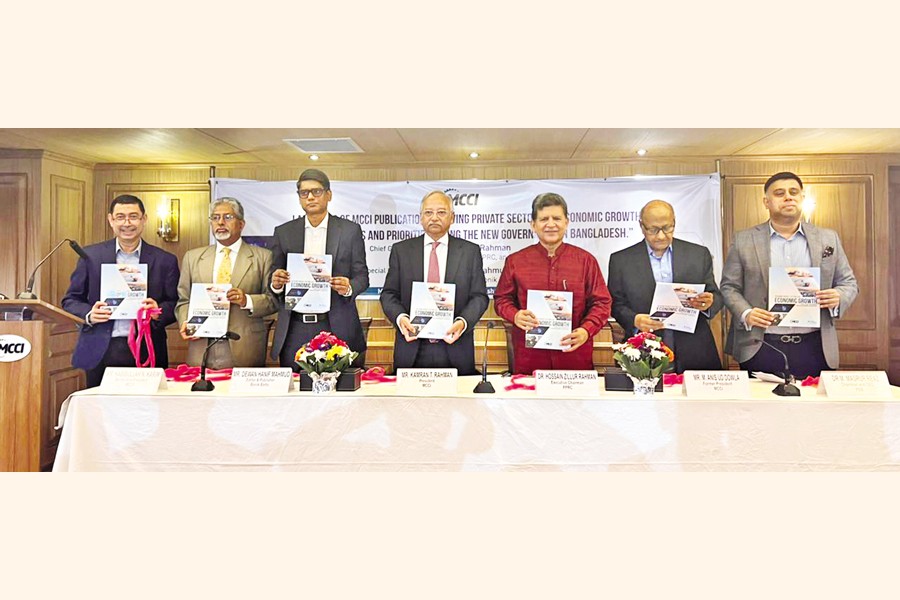
 MCCI President Kamran T Rahman, noted economist Dr Hossain Zillur Rahman and Chairman and CEO of Policy Exchange Bangladesh Dr Masrur Reaz and other participants hold copies of the MCCI Publication at its launching ceremony jointly organised by Metropolitan Chamber of Commerce and Industry, Dhaka and think-tank Policy Exchange Bangladesh at the MCCI Gulshan Office in the capital on Monday.
 A premier trade chamber presents a roadmap for the new government and urges it to take decisive steps within its first 100 days to stabilise the economy, strengthen financial management and restore private-sector confidence.
The Metropolitan Chamber of Commerce and Industry (MCCI) Monday rolled out the plan of urgent dos in its policy publication titled 'Reviving Private Sector-Led Economic Growth: Critical Issues and Priorities Facing the New Government in Bangladesh'.
 Jointly prepared by the MCCI and the think-tank Policy Exchange Bangladesh, the policy paper was presented at the chamber's office in Gulshan, where noted economists and business leaders also spoke on contingency planning for economic stability amid the Mideast war.
The speakers also stressed that Bangladesh must move beyond short-term crisis management and focus on deeper structural reforms to revive growth, strengthen institutions and restore investor confidence.
Presenting the keynote, Dr Masrur Reaz, chairman and chief executive of Policy Exchange Bangladesh, said the country was currently facing "mountain-sized challenges" that require integrated economic management.
He notes that Bangladesh has experienced significant macroeconomic stress since 2022, marked by slower growth, high inflation, weakening investment sentiment and rising vulnerabilities in the financial sector.
According to the report, GDP growth declined from 7.1 per cent in FY2022 to around 3.7 per cent in FY2025, while inflation rose from 6.15 per cent to about 10 per cent during the same period. Foreign- exchange reserves also dropped from $41.8 billion to roughly $28.6 billion, reflecting mounting external pressures.
Dr Reaz told the audience that the banking sector is under severe strain, with non-performing loans estimated to have exceeded 35 per cent, far higher than official figures.
"In financial literature, if a sector has around 10-percent NPL, it is already considered to be in crisis," he said, warning that the banking system has been under prolonged stress.
He also highlighted the growing energy deficit, noting that gas shortages and rising import costs are undermining industrial productivity and export competitiveness.
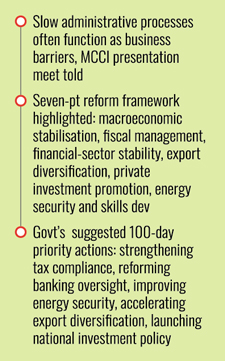
To address these challenges, the report proposes a reform framework centred on seven priority areas: macroeconomic stabilisation, fiscal management, financial-sector stability, export diversification, private investment promotion, energy security and skills development.
The study emphasises that stabilisation must be pursued alongside economic expansion. "Stability without growth risks stagnation, while growth without stability is unsustainable," the report notes.
Noted economist Dr Hossain Zillur Rahman said Bangladesh's institutional challenges go beyond corruption and include weak capacity and systemic bureaucratic barriers.
"The government has to work on harassment, corruption and institutional capacity simultaneously," he said.
He argues that institutional capacity should be measured through performance rather than training programmes, adding that slow administrative processes often function as barriers to business. Rahman also stressed the need for forensic audits of state-owned institutions to assess their real financial and operational conditions and improve accountability.
He warns against policy "short-termism," urging policymakers to focus on long-term structural transformation rather than reacting only to immediate economic crises.
Dewan Hanif Mahmud, editor and publisher of Bonik Barta, raised concerns about the reliability of national economic statistics and called for a comprehensive "stocktaking" exercise to determine the true state of the economy.
He questions whether Bangladesh's reported economic size accurately reflects reality and points to an underlying contradiction between the low tax-to-GDP ratio and high taxes on consumer goods. Mahmud also urges the government to conduct forensic audits of major state-owned enterprises and banks, including Bangladesh Petroleum Corporation, Petrobangla and several state-owned banks, as he thinks many of them are financially distressed.
He has criticised the country's energy policy, noting that large sums have been spent on LNG imports while domestic gas exploration has remained limited.
President of MCCI Kamran T Rahman said the chamber's research-based publication aims to provide policymakers with a practical roadmap for economic recovery.
bdsmile@gmail.com
© 2026 - All Rights with The Financial Express

