The government has drawn up a pipeline of 29 development projects, seeking financing from the Asian Development Bank (ADB) over the next two years as it looks to sustain infrastructure development, strengthen climate resilience, and support economic reforms.
According to the official project pipeline documents, Bangladesh plans to initiate the implementation of 10 projects in the current year and another 19 in 2027 with ADB support.
The proposed financing package includes around $5.15 billion - $2.454 billion from the lender's relatively higher rate Ordinary Capital Resources (OCR) and $2.692 billion through the Concessional OCR Lending (COL) window.
A senior official at the Economic Relations Division (ERD) says the ADB has expressed consent to finance the proposed projects.
The pipeline, jointly prepared by the ERD and the lender, has been circulated among the relevant ministries and divisions to secure formal endorsement from the implementing agencies before it is finalised, he says.
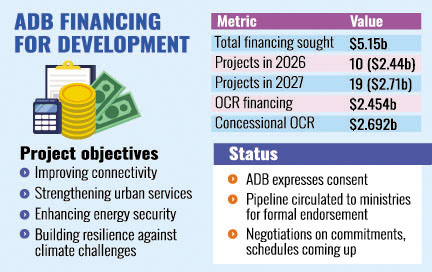
For 2026, the government has included 10 projects requiring a total of $2.44 billion, comprising $950 million in OCR financing and $1.49 billion in concessional loans.
The largest proposal is the Strengthening Economic Management and Governance Programme (Subprogramme-2) under the Finance Division, which seeks $750 million, including $450 million from OCR.
The Roads and Highways Department has proposed the second tranche of the SASEC Dhaka-Sylhet Corridor Road Investment project with a financing requirement of $300 million.
The government is also seeking $300 million for the NextGen Secondary Education Programme and $250 million for the Second Strengthening Social Resilience Programme.
Urban development and public utility projects also feature prominently in the 2026 pipeline.
The Local Government Division (LGD) has proposed the Narayanganj Green and Resilient Urban Development project with an estimated cost of $115.8 million and the Cluster Towns Water Supply and Sanitation project at $150 million.
Other projects include sustainable energy development in the Chattogram Hill Tracts, inclusive affordable housing finance, and a high-value crop commercialisation initiative.
The project pipeline expands further in 2027 with 19 projects seeking a combined $2.71 billion in ADB financing.
Of the amount, $1.50 billion is expected from OCR resources and $1.20 billion from concessional lending facilities.
Transport and logistics projects account for a significant portion of the proposed financing.
The government plans to seek $300 million for the SASEC Dhirasram Inland Container Depot project and $200 million for the Railway Rolling Stock project.
Another $150 million has been proposed for the Last-Mile Connectivity and Integration Project aimed at improving rural road connectivity.
In the energy sector, the Power Division has sought $250 million for the Power Transmission Grid Network Modernisation project and $204 million for the West Zone Power Distribution System Improvement project.
Climate adaptation and water resource management projects also occupy a prominent place in the pipeline.
The Ministry of Water Resources has proposed the Adaptive River System Management project with a financing requirement of $150 million and another $15 million for activities under the Resilient River and Canal Restoration Facility.
The LGD has included two major urban water projects in the 2027 list - the Dhaka Sewerage System Development project requiring $300 million and the Coastal Towns Water Supply Improvement project of $150 million.
The Finance Division has proposed several policy-based lending programmes, including the Sustainable Finance and Capital Market Development Subprogramme-1 with a financing requirement of $300 million and the Enhancing Competitiveness through Improved Logistics and Economic Corridor Development programme worth $200 million.
Other projects cover areas such as cyber security, universal pension support, agricultural tertiary education, social security for workers, and digital transformation of the health sector.
Officials say the proposed projects reflect the government's priority to improve connectivity, strengthen urban services, enhance energy security, and build resilience against climate-related challenges.
The pipeline will form the basis for discussions with the Manila-based lender as both sides negotiate financing commitments and implementation schedules in the coming months.
jahid.rn@gmail.com
© 2026 - All Rights with The Financial Express

