Neighbouring India outbids the United States of America to marginally emerge as Bangladesh's second-largest trading partner by February count, in a changing foreign trade dynamics.
The United States had secured the position in January, according to the latest data from Bangladesh Bureau of Statistics (BBS).
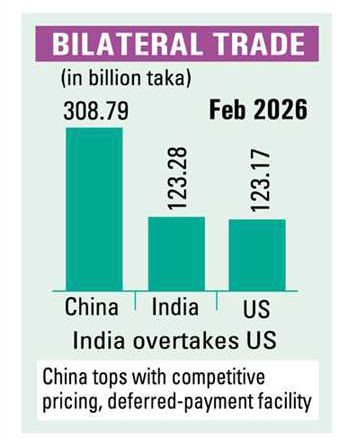
India accounted for 8.47 per cent or Tk 123.28 billion of Bangladesh's total external trade -- both export and import.
The US closely followed with an 8.46-percent share, or Tk 123.17 billion, the data show.
China, however, retains its longstanding position as Bangladesh's largest trading partner, accounting for 21.21 per cent, equivalent to Tk 308.79 billion, of the country's total trade in February.
Bangladesh mainly imports industrial raw materials, capital machinery and a wide range of finished products from China to support its manufacturing sector and growing domestic consumer market.
Chinese products continue to dominate sectors such as electronics, machinery, textile raw materials, clothing raw materials and chemicals as the imports are associated with competitive prices along with deferred -payment facility.
Imports from India largely consist of essential commodities, including rice, onions, sugar and other food items, alongside industrial raw materials required for local industries.
Bangladesh also imports cotton, yarn and various intermediate goods from the neighbouring country due to geographical proximity and relatively lower freight costs.
Meanwhile, Bangladesh primarily imports LPG, grains and agricultural produce from the United States, the world's largest economy.
The US also remains one of the key destinations for Bangladesh's garment exports, particularly readymade garments.
Among Bangladesh's other major trading partners, Indonesia ranked fourth, driven mainly by imports of industrial raw materials, edible oils and coal.
Brazil stood as the fifth-largest trading partner during the month, accounting for nearly 4.0 per cent of Bangladesh's total trade.
Bangladesh mainly imports soybean, edible oils, sugar and other agricultural commodities from the South American country.
People familiar with the developments told the FE that the country's trade pattern reflects its heavy dependence on imported raw materials and food commodities to support industrial production and meet domestic consumer demand.
"China, India and the US are likely to remain dominant trading partners in the near term due to strong economic linkages and rising bilateral trade volumes," says one trade official.
jasimharoon@yahoo.com
© 2026 - All Rights with The Financial Express

