The Islamic banking sector posted strong growth across key indicators in September 2025, with deposits, investments, total assets and remittances rising year on year, even though export proceeds declined sharply, according to the latest Bangladesh Bank (BB) data.
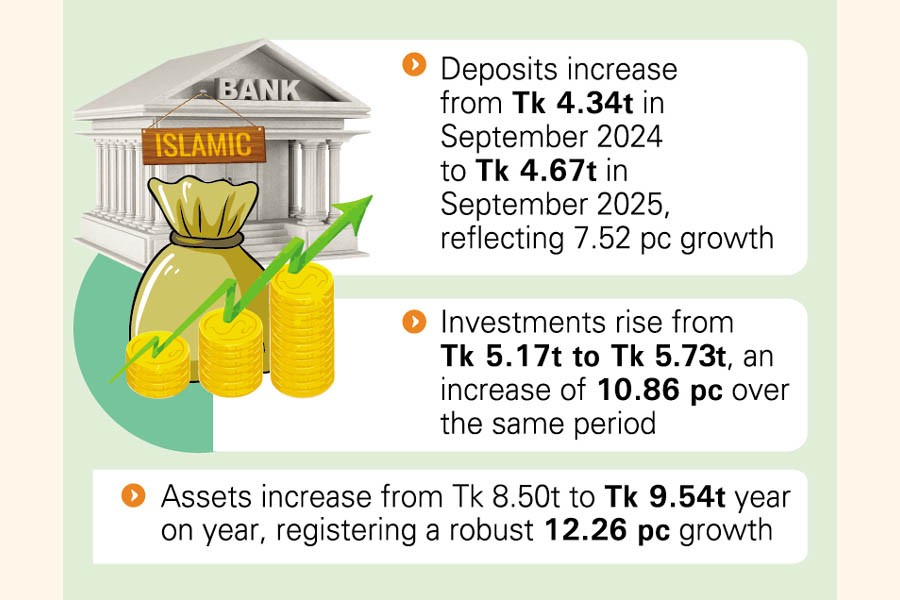
Deposits in Islamic banks increased from Tk 4.34 trillion in September 2024 to Tk 4.67 trillion in September 2025, reflecting 7.52 per cent growth.
Investments grew even faster, rising from Tk 5.17 trillion to Tk 5.73 trillion, an increase of 10.86 per cent over the same period, according to the BB data.
The total banking system also showed healthy expansion. Total banking system deposits increased from Tk 18.58 trillion in September 2024 to Tk 20.63 trillion in September 2025, reflecting a growth of nearly 11.02 per cent while total investments climbed from Tk 20.84 trillion to Tk 23.28 trillion, marking 11.72 per cent year-on-year growth.
Islamic banks' assets increased from Tk 8.50 trillion in September 2024 to Tk 9.54 trillion in September 2025, registering a robust 12.26 per cent expansion.
However, export earnings channeled through Islamic banks declined 16 per cent, falling from $837 million in September 2024 to $703 million in September 2025.
Import payments decreased from $1.07 billion in September 2024 to $1.01 billion in September 2025, which reflects a 5.23 per cent decrease as compared to the same time point of the previous year.
Islamic banks experienced their remittance share increase from around 22.45 per cent in September 2024 to around 30.44 per cent in September 2025.
From September 2024 to September 2025, Islamic banks faced robust remittances growth starting from $540 million in September 2024 to $818 million at the end of September 2025, the central bank data showed.
Islamic banks also continued to dominate agent banking deposits, holding 55.36 per cent of the total in September 2024. Their agent banking deposits rose from Tk 209 billion in September 2024 to Tk 264 billion in September 2025, a strong 26.35 per cent yearly growth.
Experts said the latest data reflects a continued shift toward Shariah-compliant banking, particularly for remittances and deposit mobilisation.
They noted that while Islamic banks are expanding rapidly in core balance-sheet indicators, the decline in export proceeds underscores external sector weaknesses linked to global demand and domestic shipment delays.
They also pointed out that Islamic banks' growing dominance in agent banking suggests stronger trust in their rural and migrant-focused services, but stressed the need for improved risk management and product diversification to sustain long-term stability.
Dr Masrur Reaz, chairman of Policy Exchange Bangladesh ( PEB), said the Islamic banking industry's steady growth demonstrates its increasing relevance in the country's financial landscape.
"The numbers highlight the strong confidence of customers, especially migrants and rural households, in Shariah-compliant banking channels," he said.
He noted, however, that the sharp fall in export earnings points to structural challenges.
"Islamic banks must diversify their product portfolios, strengthen trade finance capabilities and improve compliance standards to attract a larger share of export proceeds," Dr Reaz remarked. Dr Reaz stated that sustained growth will depend on governance reforms, tighter oversight and technology-driven service expansion.
"Islamic banks are well-positioned to play a bigger role, but they must focus on efficiency, transparency and innovation to remain competitive in a changing financial
environment," he said.
sajibur@gmail.com
© 2026 - All Rights with The Financial Express

