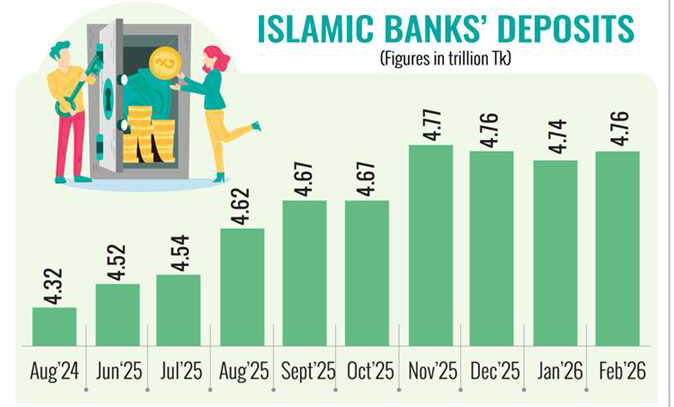
Islamic banks in Bangladesh posted moderate year-on-year growth in deposits and investments in February 2026, with deposits rising 9.27 per cent to Tk 4.76 trillion and investments increasing 11.38 per cent to Tk 5.88 trillion, indicating a gradual return of confidence in the sector.
However, month-on-month figures showed only marginal changes, reflecting a cautious and slow-paced expansion in the sector.
Deposits in Islamic banks remained almost unchanged at Tk 4.76 trillion in February 2026, compared to Tk 4.74 trillion in January, indicating no significant short-term growth, according to the central bank data.
The steady annual rise in deposits suggests Islamic banks are gradually regaining depositor confidence following disruptions after the July 2024 uprising.
Central bank liquidity support, identification of institutional weaknesses and administrative interventions appear to have played a key role in stabilising the sector.
Depositors continue to rely heavily on Mudaraba-based accounts, which account for nearly 86.85 per cent of total deposits, while the private sector dominates with more than 90 per cent of the deposit base.
Investment trends across the broader banking sector reflect a similar pattern of cautious expansion. Total banking sector investments increased to Tk 24.12 trillion in February 2026 from Tk 18.99 trillion in November 2023.
Conventional banks continue to dominate with a 75.62 per cent share, while Islamic banks hold a smaller but stable portion at 24.38 per cent.
Within Islamic banks, limited month-on-month growth in investments -- Tk 5.88 trillion in February compared to Tk 5.85 trillion in January -- highlights a conservative financing strategy.
Banks appear to be carefully managing risks amid macroeconomic uncertainties such as inflation, exchange rate volatility and tighter regulatory conditions.
Nevertheless, the year-on-year growth reflects sustained demand for Shariah-compliant financing, particularly profit-and-loss sharing models.
Asset growth in Islamic banks further supports the narrative of gradual expansion. Total assets rose to Tk 9.34 trillion in February 2026 from Tk 8.53 trillion a year earlier, reflecting a 9.46 per cent increase.
While short-term growth remains modest, the longer-term trend indicates strengthening operational capacity and market presence.
External sector performance, however, presents mixed signals.
Export receipts through Islamic banks declined to $604 million in February 2026 from $713 million a year earlier, showing a 15.26 per cent drop.
Import payments also fell sharply both month-on-month and year-on-year, indicating reduced trade activity through these institutions.
Remittance inflows, however, offered a more positive outlook.
Although remittances slightly declined to $661 million in February from $725 million in January, they recorded a strong 31.65 per cent year-on-year growth, indicating the strong position of Islamic banks in channelling expatriate income.
Agent banking continues to be a key growth driver.
Deposits in this segment rose by 27.44 per cent year-on-year to Tk 269 billion, with Islamic banks holding a dominant 54.67 per cent share, highlighting their strong outreach in rural and underserved areas.
Meanwhile, manpower in Islamic banks declined by 5.79 per cent year-on-year to 45,240 employees, reflecting ongoing digital transformation and increased automation across banking operations.
Bank insiders said the year-on-year growth in deposits and investments shows a gradual return of confidence in Islamic banks, supported by tighter oversight and reforms.
They said strong remittance growth reflects continued trust among expatriates, though lower trade transactions indicate subdued activity.
Experts said Islamic banks are gradually regaining confidence, as reflected in annual growth in deposits and investments, though month-on-month stagnation signals continued caution.
They added that strong remittance growth highlights resilience, but weak trade flows remain a concern. Stable policies and reforms are seen as key to sustaining the recovery.
Dr Masrur Reaz, chairman of Policy Exchange Bangladesh, said the year-on-year rise in deposits and investments shows a gradual recovery of confidence in Islamic banks, supported by regulatory reforms, though weak month-on-month growth signals continued caution in the sector.
He added that strong remittance growth highlights the sector's resilience in mobilising expatriate income, while subdued trade flows remain a concern.
With stability improving, he expects Islamic banks to regain further momentum.
sajibur@gmail.com
© 2026 - All Rights with The Financial Express

