Bangladesh's current- account deficit (CAD) narrowed sharply in the first 11 months of the fiscal year 2025-26, helped by record remittance inflows and slower import growth, according to the Bangladesh Bank data released Wednesday.
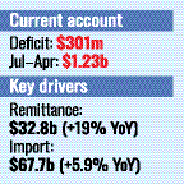
The deficit narrowed to $301 million during the July-May period of FY26 from $1.23 billion in the first 10 months.
The improvement was driven largely by stronger remittance inflows and relatively contained import growth.
Expatriate Bangladeshis sent home $32.8 billion during the July-May period, up nearly 12 per cent from the July-April period of FY26 and more than 19 per cent higher than a year earlier.
Imports rose 5.9 per cent year on year to $67.7 billion in the said period, reflecting stronger domestic demand but remaining below the pace of remittance growth.
Energy imports remained broadly stable, although petroleum imports climbed 18.6 per cent to $9.0 billion during the period under review.
Exports increased more than 11 per cent from the previous months to $44.2 billion.
However, exports were still down about 2.0 per cent from a year earlier.
The current account measures a country's transactions with the rest of the world, including trade in goods and services, investment income, and transfers such as workers' remittances.
Bangladesh typically runs a current account deficit because it imports more than it exports.
The country's export-oriented manufacturing sector relies heavily on imported raw materials and intermediate goods, while consumers also depend on a wide range of imported products.
The improvement in the current account helped lift the overall balance of payments (BoP) surplus to $4.0 billion during the July-May period, compared with $3.7 billion in the first 10 months of the fiscal year.
A year earlier, the BoP recorded a $1.1 billion deficit.
The financial account posted a surplus of $4.16 billion, although it declined by about 8.0 per cent from the July-April period.
Meanwhile, the capital account surplus increased to $366 million from $325 million.
Economists said the stronger external position reflected robust remittance inflows and resilient export earnings, helping ease pressure on Bangladesh's foreign exchange reserves.
They cautioned, however, that sustaining the improvement would depend on continued export growth, stable energy prices, and a recovery in foreign direct investment.
They said there was another sign: the capital machinery import surged by both year-on-year and on a monthly basis, 11.5 per cent and 8.6 per cent, respectively.
jasimharoon@yahoo.com
© 2026 - All Rights with The Financial Express

