Bangladesh's large-scale manufacturing sector contracted sharply in February, weighed down mainly by a steep decline in garment production amid election-related disruptions and subdued export orders.
Industry insiders and economists said fewer working days during the election period and Ramadan, coupled with uncertainty among foreign buyers, significantly affected factory operations and industrial output during the month.
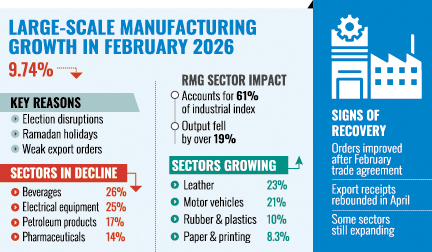
The sector contracted by 9.74 per cent in February of the current fiscal year (FY 2025-26) compared with the same month a year earlier, according to latest data released by the Bangladesh Bureau of Statistics (BBS).
The large-scale industrial sector contributes around 11 per cent to the country's gross domestic product (GDP), making it a significant indicator of overall economic performance.
The contraction was mainly driven by a sharp decline in the clothing sector, the largest component of the industrial production index with a weight of 61 per cent.
Output in the RMG sector dropped by more than 19 per cent during the month under review.
However, the textile sector, another major contributor to the index, posted marginal growth of less than 1.0 per cent compared with the corresponding period a year earlier.
Industry insiders attributed the decline to fewer working days in February due to the national elections and the holy month of Ramadan.
They also said export orders remained relatively weak during the period.
Anwar-ul-Alam Chowdhury Parvez, former president of the Bangladesh Garment Manufacturers and Exporters Association (BGMEA), told The Financial Express that many garment factories operated in a "holiday mood" during the election period in February.
He said uncertainty among foreign buyers ahead of the elections also affected order placements.
According to him, the situation improved later, which was reflected in April's export receipts that recorded growth of around 33 per cent.
Economists said global buyers had remained cautious in the months leading up to the signing of the trade agreement with Bangladesh.
They pointed out that after the interim government signed the agreement on February 09, buyers gradually increased orders as Bangladesh's competitive advantage improved.
Masrur Reaz, Chairman and Chief Executive Officer of Policy Exchange Bangladesh, told The Financial Express that uncertainty surrounding the trade agreement persisted until early February, while the election also affected industrial productivity.
He said many workers travelled to their home constituencies to cast votes after a long period without elections.
"Garment workers effectively enjoyed an extended holiday during the month and that was reflected in the industrial output," he said.
Besides garments, several other manufacturing sectors also recorded declines during the month.
The beverage sector, which carries just over 1.0 per cent weight in the index, contracted by 26 per cent.
Analysts said sectors with lower weight have a limited impact on the overall index.
Output in coke and refined petroleum products fell by 17 per cent, pharmaceutical products by more than 14 per cent and electrical equipment by 25 per cent.
In contrast, some sectors recorded notable growth during the period.
The leather sector expanded by 23 per cent, paper and printing by 8.3 per cent, rubber and plastic products by more than 10 per cent, while motor vehicle production rose by 21 per cent.
jasimharoon@yahoo.com
© 2026 - All Rights with The Financial Express

