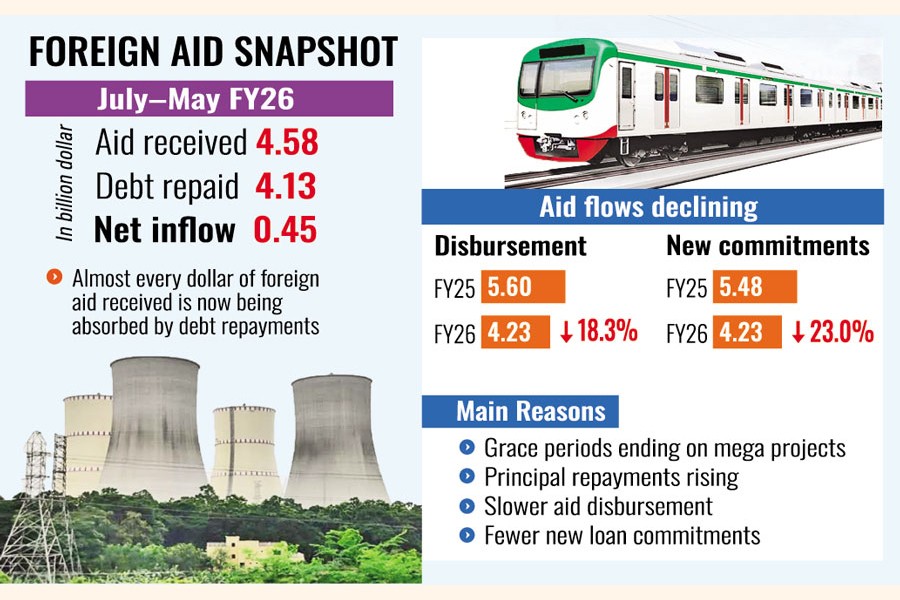
Bangladesh's net foreign aid inflow fell sharply to just US$445 million during the first 11 months of FY2025-26 as external debt servicing costs continued to rise while foreign aid disbursements and fresh commitments declined, according to official data.
The country's total external debt servicing obligations rose to $4.13 billion between July 2025 and May 2026, up from $3.78 billion during the same period of FY2024-25, according to data released by the Economic Relations Division (ERD) on Tuesday.
 With debt repayments rising faster than incoming development assistance, analysts say Bangladesh is facing growing pressure on its macroeconomic stability and fiscal space.
According to the ERD, development partners disbursed $4.577 billion in medium- and long-term loans and grants during the July-May period of the current fiscal year, while the government repaid $4.132 billion over the same period.
As a result, net foreign aid inflow stood at only $445 million during the first 11 months of FY2025-26.
Meanwhile, development partners committed $4.225 billion in foreign assistance during the period, the official data showed.
Analysts warn that Bangladesh's external debt repayments could surpass annual aid disbursements within a few years if current trends persist, as debt-servicing obligations continue to rise steadily.
ERD data show that of the $4.132 billion repaid during July-May, principal repayments accounted for US$2.684 billion, while interest payments amounted to $1.447 billion.
In local currency terms, external debt servicing absorbed a substantial Tk 505.16 billion during the period.
The sharp increase reflects the expiry of grace periods for several large infrastructure and development projects financed by foreign loans, many of which have now entered their principal repayment phases.
While expenditure on existing debt has increased, the flow of fresh foreign assistance has weakened significantly.
According to the ERD, aid commitments totalled $4.225 billion during the July-May period, which was $351.56 million lower than the amount actually disbursed during the same period.
Total foreign aid disbursements declined to $4.577 billion during the first 11 months of the fiscal year, compared with $5.60 billion in the corresponding period of FY2024-25.
Fresh foreign aid commitments also dropped by 23 per cent year-on-year to $4.225 billion.
This represents a sharp decline from the $5.48 billion in commitments secured during the same period of the previous fiscal year, largely due to fewer new project loan agreements.
The combination of shrinking inflows and record-high repayments has left Bangladesh with a net foreign aid inflow of less than half a billion dollars for most of the fiscal year, adding pressure to the country's foreign exchange management.
Economists and researchers, including those from the Centre for Policy Dialogue, have repeatedly warned about the growing mismatch between foreign aid inflows and debt-servicing obligations.
They argue that slow project implementation and bureaucratic bottlenecks continue to delay the utilisation of committed foreign funds, preventing development assistance from flowing into the economy at the expected pace.
With major bilateral loans, including financing for the Rooppur Nuclear Power Plant, expected to enter full principal repayment phases in the coming years, pressure on the national exchequer is likely to intensify further.
Experts say that unless project execution accelerates significantly and aid disbursements improve, Bangladesh will increasingly need to rely on domestic revenue mobilisation and strong remittance inflows to maintain external sector stability.
kabirhumayan@gmail.com
© 2026 - All Rights with The Financial Express

