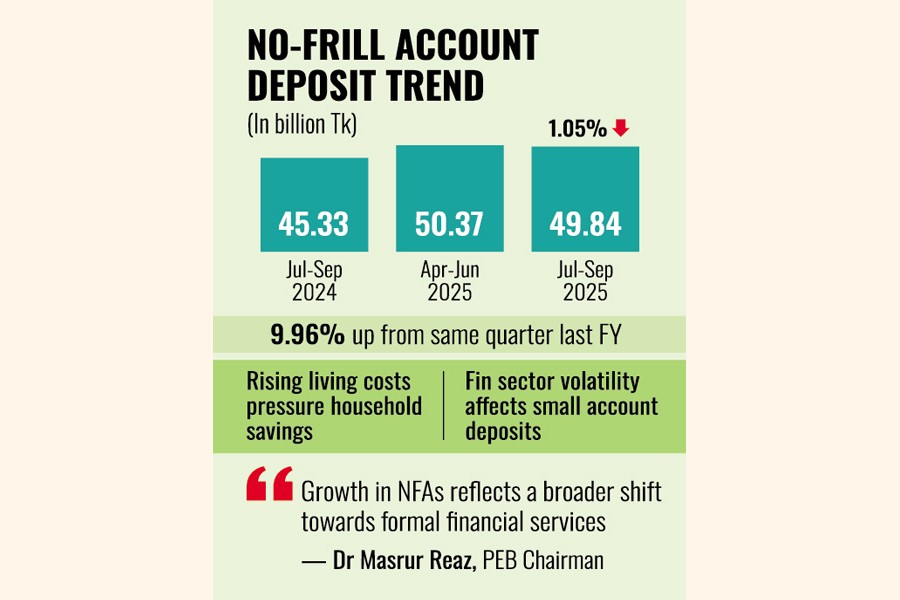
Total deposits in the No-Frill Accounts (NFAs) designed for underprivileged people stood at Tk 49.84 billion in the July-September 2025 quarter, down 1.05 per cent from the previous quarter. Rising living costs and volatility in the country's financial sector have contributed to the decline.
However, compared with the July-September 2024 quarter, the amount still represents a 9.96 per cent increase.
Deposits in the NFAs reached Tk 50.37 billion in the April-June quarter, while it was Tk 45.33 billion in the July-September 2024 quarter, according to a Bangladesh Bank (BB) report.
NFAs offer banking access to low-income groups, school students under 18, and street children, with initial deposits as low as Tk 10, 50, or 100.
The growing trend in foreign remittance that the country has been experiencing in the last few months is very important for the country's economic condition. Enhanced cooperation between banks and exchange houses has reduced dependency on informal systems, which has resulted in an increase in foreign remittance.
Up to September 2025, the cumulative amount of foreign remittances received through these accounts reaches Tk 8.14 billion. The amount is 1.76 per cent higher than the cumulative amount received by the end of the June 2025 quarter.
BB introduced Tk 10 accounts for farmers in 2010 as one of the significant financial inclusion initiatives to bring rural communities living on agriculture under the umbrella of formal financial services.
As of September 2025, the total number of accounts for farmers increased to over 10.55 million, which is 1.68 per cent higher than that of the previous quarter. The total deposit in the accounts for farmers stands at over Tk 8.0 billion, which is 4.02 per cent higher than that of the previous quarter.
Poverty reduction is one of the major policy objectives of BB. The central bank has advised all banks to open accounts for the extreme poor so that they can receive various government financial support through the banking channel. Tk 10 accounts also provide the extreme poor with opportunities to save their hard-earned money.
As of September 2025, the number of accounts for the extreme poor reached over 3.42 million -- 1.44 per cent higher than the previous quarter and 3.06 per cent higher than the September 2024 quarter.
Deposit in the accounts for the extreme poor has increased by 5.85 per cent over the previous quarter and increased 7.14 per cent over the September 2024 quarter.
Government's Social Safety Net (SSN) programmes greatly contribute to supporting the marginal people of society. Poor people can receive SSN allowances through Tk 10 accounts.
BB has advised all banks to open SSN accounts for the beneficiaries of SSN programmes with only the documentation requirement of National Identity Card (NID) and Pension Payment Order (PPO) book.
It is noteworthy that during the COVID-19 pandemic, the government used these accounts for the beneficiaries of SSN programmes to distribute cash allowances among financially affected low-income families.
The number of Tk 10 accounts for the beneficiaries of SSN has increased by 0.87 per cent in the reporting quarter from the previous quarter and increased by 3.48 per cent over the September 2024 quarter.
The amount of deposits in these accounts has decreased by 5.39 per cent compared to that of the previous quarter but increased by 11.00 per cent compared with the September 2024 quarter.
The number of Tk 100 accounts for RMG workers has increased by 1.92 per cent in the reporting quarter over the previous quarter and increased by 24.57 per cent over the September 2024 quarter.
This trend indicates that more RMG workers are opening bank accounts, which is helping to expand the financial inclusion network. Deposit in these bank accounts has increased by 5.00 per cent over the previous quarter and increased by 35.52 per cent over September 2024.
NFA has been considered as one of the most effective ways to expand financial inclusion to the underserved segment of the population.
The growth in NFA needs to be accelerated in order to achieve the goal of National Financial Inclusion Strategies-Bangladesh (NFIS-B), where it is targeted to confirm bank accounts for all adults by 2026, the BB report suggested.
Dr Masrur Reaz, chairman of Policy Exchange Bangladesh, said the growth in no-frills accounts reflects a broader shift towards formal financial services, particularly among low-income and marginalised communities.
He pointed out that the sustained inflow of foreign remittances through banking channels is reinforcing trust and gradually reducing reliance on informal systems.
Dr Reaz also noted that, although overall deposit growth in small-scale accounts remains positive on a year-on-year basis, quarterly volatility suggests that rising living costs continue to pressure household savings, especially among vulnerable groups.
sajibur@gmail.com
© 2026 - All Rights with The Financial Express

