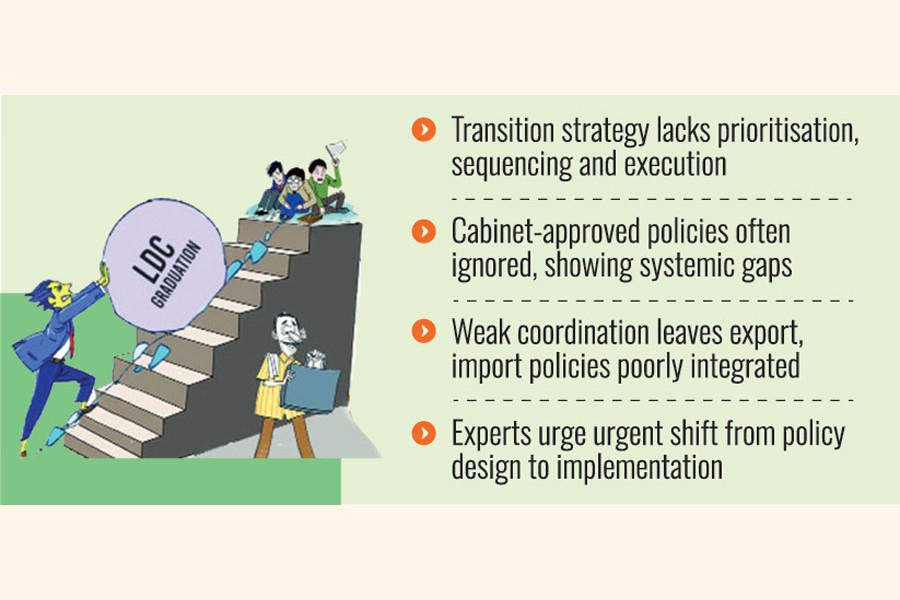
Policymakers, economists and development partners have warned of a persistent gap between policy formulation and execution as Bangladesh prepares for its transition from Least-Developed Country (LDC) status.
The concerns emerged at a knowledge-dissemination event titled "Bangladesh's Economic Transition: Trade, Competitiveness, and Structural Reform", held on Sunday and organised by the South Asian Network on Economic Modelling (SANEM) in partnership with the Australian High Commission at the BRAC Centre Inn in the capital.
Delivering the keynote, Dr Selim Raihan, executive director of SANEM, said that while Bangladesh's graduation reflects progress, preparedness for post-LDC realities remains uncertain.
He noted that the country's Smooth Transition Strategy shows ambition but lacks prioritisation, sequencing and effective execution.
Speaking as chief guest, Abdur Rahim Khan, additional secretary at the Ministry of Commerce, pointed to a systemic "disconnect" between approved policies and their implementation.
He said even cabinet-approved frameworks, including the National Tariff Policy, are often ignored in practice.
Mr Khan also flagged weak coordination in trade strategy, noting that export and import policies remain poorly integrated.
He further warned of a "policy security problem", where frameworks are frequently replaced before achieving intended outcomes, urging a shift from seeking new solutions to implementing existing reforms.
"The train is not missed… we just need to be focused," he said. From the private sector, textile sector leader Fazlul Haque expressed scepticism over the country's readiness for LDC graduation, saying, "We are not ready at all… we are not mentally ready even to go for all the corrections we need."
He questioned the effectiveness of any potential deferral, citing growing complacency, and described longstanding issues -- such as the leather sector's effluent treatment failures -- as evidence of deeper leadership shortcomings. Providing an international perspective, Clinton Pobke of the Australian High Commission stressed that early signals of reform commitment are critical to anchoring investor confidence.
He underscored the need for revenue reform and a gradual shift away from tariff dependence, adding that Australia could support Bangladesh in areas such as energy security.
bdsmile@gmail.com
© 2026 - All Rights with The Financial Express

