The push to expand agro-processing is running up against a fundamental constraint: much of the country's farm output does not meet industrial specifications.
Despite frequent bumper harvests driven by fertile alluvial soil, ample freshwater and a monsoon-based agro-climate, processors say the quality of domestic produce often falls short of factory requirements.
The issue is not supply, but suitability. Undersized crops, high moisture content, low flesh yield and excessive seeds are common complaints, forcing processors to import raw materials and undermining efforts to build robust, value-added supply chains at home.
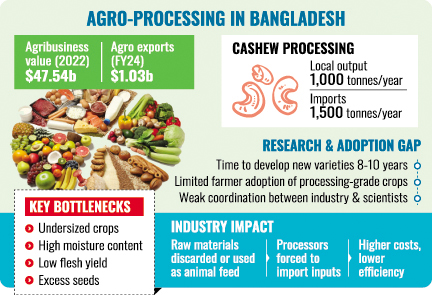
The country regularly produces large volumes of potatoes, tomatoes, chillies, carrots, guava, pineapple and other crops. However, agro-processors say local produce often fails to meet factory specifications, increasing processing costs and reducing efficiency at scale.
Processors complain that domestic crops are frequently too small, contain excess moisture, lack sufficient flesh or have too many seeds.
As a result, sizeable quantities are discarded or diverted to animal feed, even as factories import alternatives to keep production lines running.
This disconnect has become more visible as non-traditional players enter agro-processing.
The country's largest steelmaker, BSRM, has invested nearly Tk 100 million to establish a cashew nut processing plant in Chattogram. The project, however, has struggled from the outset due to a shortage of suitable raw materials.
"We need high-quality fresh cashew nuts for processing, but the size available locally is not suitable for commercial purposes," said Aameir Ali Hussain, managing director of BSRM.
"Most local produce comes from the Chattogram Hill Tracts, particularly Bandarban, but these do not meet industrial processing requirements. That is why we rely on imports," he said, adding that the company sources cashew nuts from African countries, including Ivory Coast.
Industry executives say BSRM's experience is far from unique. Across multiple segments, from fruit pulp and juice to spices and snack foods, companies report similar challenges.
Pran-RFL Group, the country's largest agro-processor with annual turnover of about $3.0 billion, says it cannot rely on most local crop varieties for industrial use due to the absence of processing-friendly varieties.
"We cannot use local varieties as they do not meet industrial requirements," said Kamruzzaman Kamal, director of marketing at Pran-RFL.
He cited high moisture content, low flesh yield and excessive seeds as key limitations, stressing the need for hybrid varieties tailored to processing needs, alongside good agricultural practices to ensure food safety.
The consequence, industry players argue, is growing dependence on imported raw materials and seeds - raising costs, worsening the trade balance and weakening incentives for local farmers.
Pran-RFL produces tomatoes through contract farming under its supervision, but uses Indian seeds that meet industrial requirements. The company manufactures sauces and other tomato-based products, while many other processors rely on imported tomato pulp.
Researchers acknowledge the gap but describe it as structural. Scientists at public research institutes such as the Bangladesh Agricultural Research Institute (BARI) in Gazipur say they are developing industry-friendly varieties, though adoption remains limited.
"There is a gap between our innovation and farmers' practices," said Dr Md Selim Uddin, breeder and chief scientific officer at BARI. "Farmers mainly produce for fresh markets, not for industry. Companies need to actively motivate farmers to adopt varieties suited for processing."
Dr Abdul Gaffar, a prominent agricultural scientist who has developed several tomato varieties, said research priorities traditionally focus on mass consumption before industrial use.
"We prioritise food security for a large population. Industrial varieties come later," he said, noting that BARI-19, a tomato variety suitable for processing, has yet to gain popularity.
He attributed this partly to weak coordination, adding that industry technicians rarely sit with scientists to define clear specifications.
Land scarcity further complicates the issue. With limited farmland, farmers are reluctant to allocate land to specialised varieties that may not fetch higher prices in traditional markets.
Developing new varieties is also time-consuming. "Variety innovation cannot happen overnight. It takes at least eight to 10 years," Dr Gaffar said.
Meanwhile, the government has launched projects to promote non-conventional crops in fallow and hilly areas, particularly in the Chattogram Hill Tracts. Cashew nut and coffee cultivation are being encouraged under this initiative.
Bangladesh currently produces about 1,000 tonnes of cashew nuts annually, while importing around 1,500 tonnes from countries such as India and Vietnam, according to project officials.
Demand is rising as consumers become more health-conscious and the urban middle class expands.
Shahidul Islam, project director of the Research, Development and Extension of Cashew Nut and Coffee Project under the Department of Agricultural Extension, said Cambodian cashew varieties have been planted on 4,000 acres of fallow land and are expected to yield commercially within five years.
He added that BARI has developed a new cashew variety that may be released within months.
Industry executives argue that scaling up local varieties aligned with industrial requirements is critical not only for processors, but also for farmers and public finances.
A BSRM official said widespread under-invoicing in cashew nut imports deprives the government of tax revenue, while farmers earn less and processors struggle to remain competitive.
"Many cashew nut processors could not survive due to unhealthy competition," said a senior official at BSRM's cashew processing unit in Chattogram.
Bangladesh's domestic agribusiness was valued at $47.54 billion in 2022, according to the Bangladesh Investment Development Authority, while agro-exports reached $1.03 billion in fiscal year 2024 - figures that underline both the sector's potential and the cost of failing to bridge the farm-to-factory gap.
jasimharoon@yahoo.com
© 2026 - All Rights with The Financial Express

