Remittance inflows have surged sharply in the run-up to Eid-ul-Fitr, providing a crucial boost to the country's external sector despite mounting geopolitical tensions in key migrant-destination regions.
Central bank officials say the strong inflow reflects seasonal support from expatriates, but warn that prolonged conflict in the Middle East could disrupt migration and income flows, potentially slowing remittance growth in the coming months.
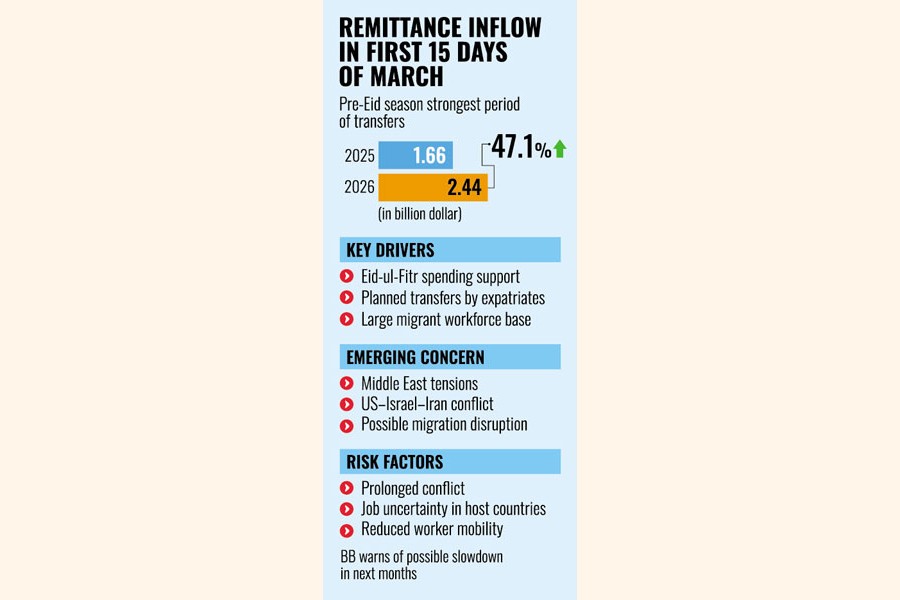
The country received nearly US$2.50 billion in remittances during the first 15 days of this month, according to the central bank's latest data.
The inflow registered a robust 47.10 per cent growth to $2.44 billion during the period under review, up from $1.66 billion in the same period of the previous year.
The inward remittances continue to show strong growth despite intensifying tensions across the Middle East following the joint military strikes by the United States and Israel on Iran, officials said. The inflows have yet to face any major setback despite the geopolitical tensions; instead, they have increased compared with previous periods, they added.
"The current higher inflow of remittances reflects earlier plans by expatriates to support their families ahead of the Eid festival," a senior official of the Bangladesh Bank (BB) told The Financial Express (FE) on Tuesday.
He also said the impact of the Middle East conflict on inward remittances may emerge from next month if tensions persist.
In a recent report, the central bank said remittance inflows could slow due to migration disruptions and economic uncertainty in the Middle East amid the US-Israel conflict involving Iran.
"Despite high remittance inflows supported by a large stock of existing migrant workers, remittance growth could slow due to migration disruptions and economic uncertainty in host countries," the central bank said in its report titled 'Quarterly Report on Remittance Inflows in Bangladesh: October-December of FY26', released on Monday.
The magnitude of the impact will largely depend on the duration and geographic spread of the conflict, according to the report.
"A brief conflict may have only limited effects, whereas a prolonged regional crisis could significantly reduce remittance inflows and intensify pressure on Bangladesh's external sector," the central bank noted.
siddique.islam@gmail.com
© 2026 - All Rights with The Financial Express

