Apparel exporters have raised concerns that the government's proposed 20 per cent safeguard duty on yarn imports, aimed at protecting local spinning mills, could push buyers to shift orders to other countries.
According to industry sources, some buyers have already expressed worries as they have nominations to import yarn from Indian spinners due to lower production costs.
Bangladesh Knitwear Manufacturers and Exporters Association (BKMEA) Executive President Fazlee Shamim Ehsan has told The Financial Express buyers typically shift sourcing countries if the production cost gap exceeds 5 per cent.
"Some of our buyers have already conveyed concerns over the government's recent move to impose a safeguard duty on yarn imports," he notes.
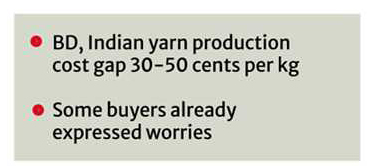
He adds that there is a 30-50 cent production cost gap per kg between Indian and Bangladeshi yarn, and the government should consider alternative incentives instead of tariffs.
"Imposing a safeguard duty will not be an appropriate way to encourage the use of higher-cost local yarn," he says.
Referring to a previous incident of yarn import suspension through land ports, Ehsan says a leading UK buyer relocated part of its orders to India due to the disruption despite importing significant volumes of apparel from Bangladesh for its Indian retail market.
The ongoing dispute between Bangladeshi textile millers and apparel exporters over yarn imports has left buyers concerned.
Leaders of both associations are lobbying the government for support, but their demands are contradictory, industry insiders say.
Tensions escalated after the government suspended yarn imports through land ports, responding to demands from local millers.
Apparel exporters termed the decision a hasty one.
Currently, spinners are requesting the government to either impose a safeguard duty on yarn imports or exclude 10-30 count yarn from the duty-free import bond facility.
Apparel and knitwear manufacturers, however, oppose these measures, arguing that the tariffs will raise production costs, force them to buy higher-cost local yarn, and hurt exports.
"If the government makes such a decision, it will push up production costs and may force buyers to move orders abroad," says Urmi Group Managing Director Asif Ashraf.
He says restricting imports is illogical in a free-market economy.
The government could study the reasons behind the loss of price competitiveness of local spinners, he also says.
Citing the recent hike in gas prices as a key factor eroding competitiveness, he recommends gas subsidies to help spinners remain competitive in the export market.
"Gas subsidies could be a long-term solution. We have to keep the spinning sector alive for a sustainable readymade garment (RMG) industry," says Ashraf.
He also notes that after graduating from the least developed country (LDC) status, the government will no longer be allowed to provide cash incentives for exports under the World Trade Organisation (WTO) rules.
BKMEA's Ehsan points out that previous yarn import suspensions through land ports, in response to millers' demands, failed to make local spinners' prices competitive.
Referring to yarn import data under the bond facility, he says there was a year-on-year decline during the July-December period of FY26, while imports from India remained stable, reflecting a shift in sourcing amid policy tightening. Data shows yarn imports under bond fell 8.10 per cent to 345,577.82 tonnes between July and December of FY26 from 376,060.4 tonnes in the same period of the previous fiscal year.
In contrast, imports from India declined by 7.60 per cent to 337,854.49 tonnes in July-December of FY26 from 365,563.24 tonnes in the same period of a year ago.
Overall, year-on-year yarn imports declined, indicating subdued demand and efforts to curb bonded imports to protect local spinning mills, while Indian yarn remains competitive due to the cost of production.
The BKMEA executive president also proposes reintroducing the previous 4 per cent cash incentive on the use of local yarn, which is currently 1.5 per cent, to help domestic millers remain competitive in the export market.
newsmanjasi@gmail.com
© 2026 - All Rights with The Financial Express

