Bangladesh's economic structures have shown a complex shift as the share of manufacturing has declined despite a little gain in employment, the 2024 Economic Census report says.
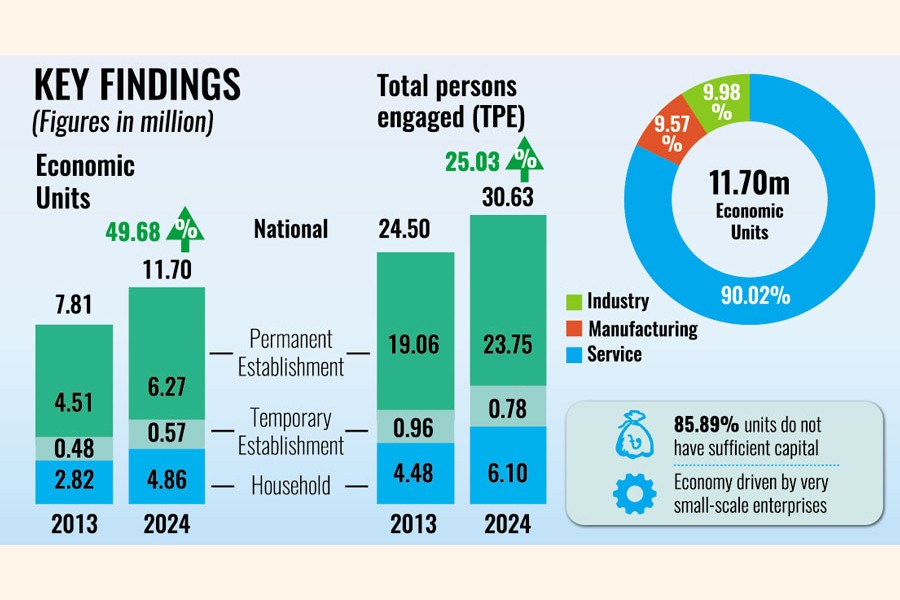
While the total number of economic units has surged to over 11.70 million from 7.82 million in 2013, the manufacturing sector's share has notably contracted, the report revealed by the Bangladesh Bureau of Statistics (BBS) on Tuesday said.
The national statistical body unveiled the report at a function where State Minister for Planning Zonayed Saki was the chief guest.
According to the report, the manufacturing sector now accounts for 9.57 per cent of the country's total economic units, a decline from the 11.1 per cent recorded in 2013.
Despite this drop in the proportion of physical units, the sector saw a marginal increase in its share of total employment.
The proportion of the Total Persons Engaged (TPE) in the manufacturing sector rose to 29.47 per cent in 2024, up from 29.32 per cent in the previous census, the BBS data showed.
The manufacturing sector now ranks as the fourth-largest category in terms of economic units, significantly trailing behind the Wholesale and Retail Trade (40.19 per cent), Transportation and Storage (22.22 per cent), and Other Service Activities (10.31 per cent).
The report paints a stark picture of the financial hurdles facing Bangladeshi businesses.
A staggering 85.89 per cent of economic units reported facing an unavailability of sufficient capital.
This shortfall is identified as the single largest barrier to business operations and expansion.
Furthermore, the "easy loan" remains elusive for many, with 34.42 per cent of units specifically citing a lack of easy access to loans from commercial banks and financial institutions as a primary difficulty.
Other major operational challenges include Infrastructural Problems (18.77 per cent), Rising Production Costs (9.70 per cent), Skilled Manpower Shortages (9.46 per cent), and Electricity and Fuel Issues (8.02 per cent).
The 2024 data underscores the overwhelming dominance of the service sector, which now hosts 90.02 per cent (approximately 10.53 million) of all economic units.
In contrast, the industrial sector accounts for only 9.98 per cent (1.17 million units).
Structurally, the economy remains driven by very small-scale enterprises, according to the census.
Micro and cottage industries combined make up more than 95 per cent of all economic units in the country.
Micro Industries accounts for 56.67 per cent (6.63 million units), Cottage Industries 38.74 per cent (4.53 million units), Small Industries 4.21 per cent, and Medium and Large Industries less than 0.4 per cent.
The growth in economic units was observed across the board, with rural areas now housing 7.38 million units compared to 4.32 million in urban centres.
In 2013, these figures stood at 5.59 million and 2.23 million, respectively, indicating a rapid expansion of economic activity in both settings over the last decade.
According to the 2024 census, the average size of permanent establishments in 2024 was 3.79.
In the case of personal/individual/family-run establishments, the size is 1.92.
Furthermore, the sizes for private limited companies are 67.11, government 13.64, non-profit institutions (NPI) 3.99, public limited companies 26.11, joint ownership (domestic & foreign) 142.85, and foreign ownership organisations 468.63.
A total of 14,664 foreigners were engaged in various economic units.
Of them, the highest 3,991 persons (27.22 per cent) were Chinese, followed by Russians at 22.73 per cent, Indians at 13.01 per cent, Kazakhstanis at 8.78 per cent, Sri Lankans at 4.44 per cent, and South Koreans at 3.60 per cent.
The 2024 census was conducted using Computer Assisted Personal Interviewing (CAPI) and involved over 87,000 enumerators nationwide to map the changing face of the non-agricultural economy.
At the inauguration session, State Minister for Planning Zonayed said the government was working on easing the obstacles to business.
"We have a lot of hurdles on the way to starting a business. We have to work massively to make establishing a business easy.
Then we will get more investments," he said.
Besides, Bangladesh needs expansion in the Cottage, Micro, Small, and Medium Enterprise (CMSME) sector for getting employment gains and reducing poverty, he said.
© 2026 - All Rights with The Financial Express

