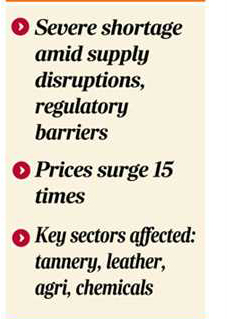
The ongoing sulphur and sulphuric acid crisis has intensified due to supply disruptions, regulatory bottlenecks, and alleged market manipulation, raising concerns across key industrial sectors, people familiar with the development say.
Despite a strong demand from the tannery and leather sectors, supply constraints have triggered an abnormal price surge, disrupting production and increasing costs for downstream industries.
The US-Israel conflict with Iran has closed the Strait of Hormuz, causing a supply disruption.
This has restricted the flow of raw materials, leading to a shortage in the sulphuric acid market.
Local production of sulphuric acid stands at around 0.15 million metric tonnes annually, supporting a domestic market valued between Tk 25 billion and Tk 30 billion, according to sector insiders.
However, supply remains insufficient to meet the growing demand.
Industry insiders say due to high import costs and persistent barriers, only two importers are currently active in the market.
They further allege that four local private producers are dominating the market and creating barriers for importers, who are already burdened with high duties.
"Local producers do not pay any duty, whereas we have to pay around 83 per cent import duty," one of them adds.
A member of the Bangladesh Acid Merchant Association, on condition of anonymity, says the crisis has reached a critical stage.
He says the ongoing crisis in the domestic chemical market has reached a critical juncture, as the price of sulphuric acid, widely regarded as the mother of all chemicals, has increased 15 times of its original rate.
According to him, this price hike is largely attributed to an artificial supply crunch orchestrated by a syndicate of some private sector entities.
He says beyond the immediate price pressures, the sector is grappling with significant regulatory bottlenecks that are stifling industrial growth.
Industry representatives emphasise that the process of obtaining essential licences has become increasingly arduous, further hampering the distribution and utilisation of this vital industrial item.
Given that sulphuric acid is an indispensable catalyst for almost all chemical manufacturing processes, the association member warns that without immediate government intervention to curb market syndicates and streamline the licensing framework, the broader manufacturing landscape faces a severe operational threat.
Stakeholders also point to regional price disparities, noting that sulphuric acid remains significantly cheaper in neighbouring countries like India and Pakistan, putting Bangladeshi manufacturers at a disadvantage.
While TSP Complex Limited (TSPCL) in North Patenga of Chattogram remains the primary government-owned facility under the Bangladesh Chemical Industries Corporation (BCIC), its production remains halted.
Talking to The Financial Express, Engr Sen Sukhen Chandra, managing director of TSPCL, says the production of sulphuric acid has been completely halted due to mechanical faults.
"We suspended production because of issues with acid-proof bricks supplied by Bangladesh Insulator and Sanitaryware Factory Limited (BISF)," he says.
According to him, BISF is currently unable to produce the required bricks due to the ongoing gas crisis.
He also acknowledges that the price of sulphuric acid has increased by 10 to 12 times. While global factors, such as tensions involving the US and Iran, have had some impacts, he notes that local market manipulation has played a role in driving up prices.
Chandra says the company will soon float a tender to procure the necessary bricks. He adds that sulphuric acid prices remain stable in India, and importing from India or China could be a viable option as prices there are lower.
Furthermore, he mentions that there is uncertainty over the immediate resumption of production as operations can only restart after the tender process is completed and the required materials are secured. Currently, four private factories in the country are producing sulphuric acid, he says.
People familiar with the development say the prolonged shutdowns of TSP fertiliser production were carried out in coordination with local producers, further tightening supply.
MA Faruk, proprietor of Faruk Chemical Company, says the market is currently facing a severe shortage due to artificial barriers to imports.
"There is a huge demand in the market right now as different sectors, including agriculture and tannery, are actively using sulphuric acid," he says.
He claims that prices have skyrocketed by 500 to 600 per cent in a short period.
"A vested interest group, including some customs officials in Dhaka and Benapole, is creating barriers to imports," he alleges.
Faruk says he recently faced significant obstacles while trying to clear a consignment through the Benapole port.
"I had to approach the revenue board chairman to resolve the issue," he says, adding that such interference has discouraged importers.
According to him, he stopped importing sulphuric acid in 2021 due to similar challenges and only resumed recently, but the situation remains largely unchanged.
"I am still facing obstructions as some vested interest groups are involved in controlling the market," he says.
He stresses that sulphuric acid should be declared a "mandatory product", given its essential role in multiple industries.
Faruk also says he filed complaints with the Anti-Corruption Commission against certain customs officials over irregularities in 2021.
"Despite the allegation, no action was taken, and I had to stop imports due to high costs and regulatory hurdles," he adds.
Md Shariful Islam, proprietor of M/S Azad Chemical Co and president of the Bangladesh Chemical and Perfumery Merchant Association, says he has filed complaints with the Ministry of Home Affairs, the deputy commissioner, and the Ministry of Commerce, urging immediate action.
However, no effective measures have been taken so far, he adds.
He says the product is currently selling at Tk 180 per kg, whereas about a month and a half ago, the price surged to Tk 220 per kg, up from Tk 30-35 earlier.
"The government should have acted earlier, but they did not pay heed to our concerns, which led to an abnormal price hike," he says, adding that a syndicate is now exploiting market vulnerabilities.
He also says if the rise was truly driven by the Iran-US conflict, prices would have started declining by now.
sajibur@gmail.com
© 2026 - All Rights with The Financial Express

