 Bangladesh's currency appears increasingly getting overvalued as subdued import demand and weak private-sector credit flows coincide with robust remittance inflows.
The trend is reflected in the central bank's latest reading of the real effective exchange rate (REER) index, which rose to 103.84 in August from 101.23 a month before.
A key gauge of currency valuation against a basket of 15 trading partners accounting for more than 80 per cent of Bangladesh's commerce-REER signals that the taka is stronger than its equilibrium level.
A REER value below 100 typically indicates enhanced export competitiveness, while a level above 100 suggests a stronger local currency that dampens export and makes imports cheaper
Based on the August 2025 reading, the dollar should be priced Tk126.31. Instead, it traded at Tk121.64, leaving the taka overvalued by Tk4.67, according to Bangladesh Bank data.
People familiar with the matter at the central bank of Bangladesh say the regulator is purchasing dollars to narrow the gap.
"We're rightly buying dollars, otherwise the difference would have been wider," one central banker told the FE on Thursday.
Since July, the central bank has bought US$1.88 billion through multiple purchases from the market.
They point out that private-sector credit growth has remained weak for months, limiting import demand and keeping foreign-exchange inflows comfortable.
"Bangladesh has adequate dollar inflows. We will continue buying to minimise the gap, but there will be no direct intervention in the market," the banker adds.
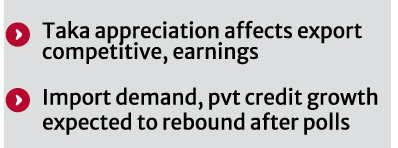
Economists warn that the currency's overvaluation risks undermining trade competitiveness, particularly for exporters. "This is having a negative impact on export earnings," says Dr M Masrur Reaz, chairman of Policy Exchange Bangladesh.
"We enjoyed a favourable position in recent months, but the situation is now becoming volatile."
He mentions that the rise in the REER leads to higher domestic inflation relative to Bangladesh's trading partners but expresses optimism that inflationary pressures would ease in the coming months.
"After the general election, import demand will rebound and private- sector activity-the real engine of the economy-will accelerate," Dr Masrur hopes.
The credit to the private sector was recorded at 6.52 per cent in July 2025 on a year-on-year basis and it was negative 0.29 per cent in July 2025 over June 25, according to Bangladesh Bank statistics.
Bangladesh Bank chief economist Dr Akhtar Hossain says sluggish imports reflected slower private-sector investment in the country. "Once private investment gains momentum, import demand will rise," he says, suggesting that currency equilibrium could be restored then.
He underscores the need for a strong push in foreign direct investment, as domestic savings have remained stuck at around 23 per cent of GDP for years and the investment also remained stagnant at around 30 per cent. "We are desperately seeking FDI, and such investment will accelerate growth."
Dr Hossain adds that the ample inflow of foreign exchange is a key reason behind the taka's appreciation.
In the meantime, the worker remittance inflow hit US$30.0 billion in the fiscal year 2025 by growing nearly 27 per cent during the period.
jasimharoon@yahoo.com
© 2026 - All Rights with The Financial Express

