A government project to establish 329 technical schools and colleges across Bangladesh has made minimal progress more than six years after its approval, raising fresh concerns over implementation capacity and project management.
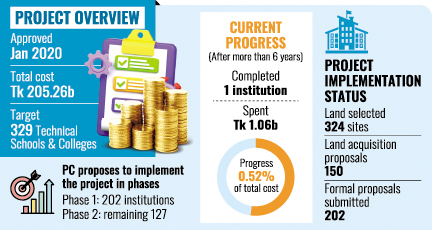
Officials say that despite the massive Tk 205.26 billion allocation for the project approved in January 2020, only one institution has been completed so far, with a total expenditure reaching just Tk 1.06 billion, or 0.52 per cent of the project cost.
The sorry state has prompted the Planning Commission (PC) and monitoring authorities to suggest scaling down the project and implementing it in phases, they said.
With no further spending allowed without extending the tenure, the current fiscal year's allocation in the Revised Annual Development Programme (RADP) stands at only Tk 1.29 billion.
Considering implementation capacity, the Planning Commission and the Implementation Monitoring and Evaluation Division (IMED) have advised completing the project in two phases.
However, the Technical and Madrasa Education Division of the education ministry remains unwilling to follow this recommendation, officials said.
They said the Technical and Madrasa Education Division (TMED) of the Ministry of Education has recently sent the first revision proposal of the project to the Planning Commission, seeking to keep the original scope intact while extending the implementation deadline by three more years until December 2028.
The Technical and Madrasa Education Division rejected plans to fragment the project, warning that excluding certain areas could spark negative reactions.
In a letter signed by Deputy Secretary S. M. Basir Ullah, the division noted that land acquisition is ongoing in all 329 upazilas and that no clear criteria exist to determine which upazilas should be dropped.
The letter argued that the project was designed to expand technical and vocational education opportunities across all upazilas in the country and that excluding some areas at this stage could hamper attainment of the goal.
Earlier in December last year, the Planning Commission arranged a meeting of the Project Evaluation Committee (PEC) to assess the revision proposal and suggested that the project's scope be revised in line with the actual pace of implementation.
The minutes of the PEC reveal that the meeting recommended that the revised proposal include only 202 TSCs for immediate implementation, based on land acquisition proposals already received from district and upazila administrations.
The remaining 127 institutions could be considered under a separate project later after reviewing demand, land availability and implementation capacity, the committee suggested.
Planning Commission officials say the recommendation was made to make the project more realistic and manageable.
"Land acquisition is a major prerequisite for starting construction, but in many cases the process has not even begun," said a senior official involved in the evaluation.
Implementing all 329 institutions simultaneously under the current conditions would be extremely difficult, the official explained.
Data presented at the PEC meeting showed that despite more than five years having passed since the project began, progress has remained very limited.
Of the planned institutions, only one has completed both land acquisition and construction and is expected to start academic activities.
Land selection has been completed for 324 locations, but final land acquisition proposals have been processed for only about 150 sites. Officials said that district and upazila administrations have formally submitted land acquisition proposals for 202 institutions, which formed the basis for the PEC recommendation.
The slow progress has also drawn attention from IMED, which earlier identified the project among several slow-moving and stalled projects requiring special monitoring.
According to IMED observations, the project has faced multiple implementation challenges, including difficulties in acquiring suitable land, delays in obtaining environmental clearance, lengthy administrative procedures in land acquisition and a shortage of project manpower.
In some cases, the estimated land prices mentioned in the development project proposal were lower than the prevailing mouza rates, making it difficult to secure land, officials said.
The situation was further complicated by disruptions caused by the Covid-19 pandemic soon after the project began.
IMED earlier recommended strengthening monitoring, preparing a more realistic work plan and considering phased implementation of the project in line with budget allocations and implementation capacity.
jahid.rn@gmail.com
© 2026 - All Rights with The Financial Express

