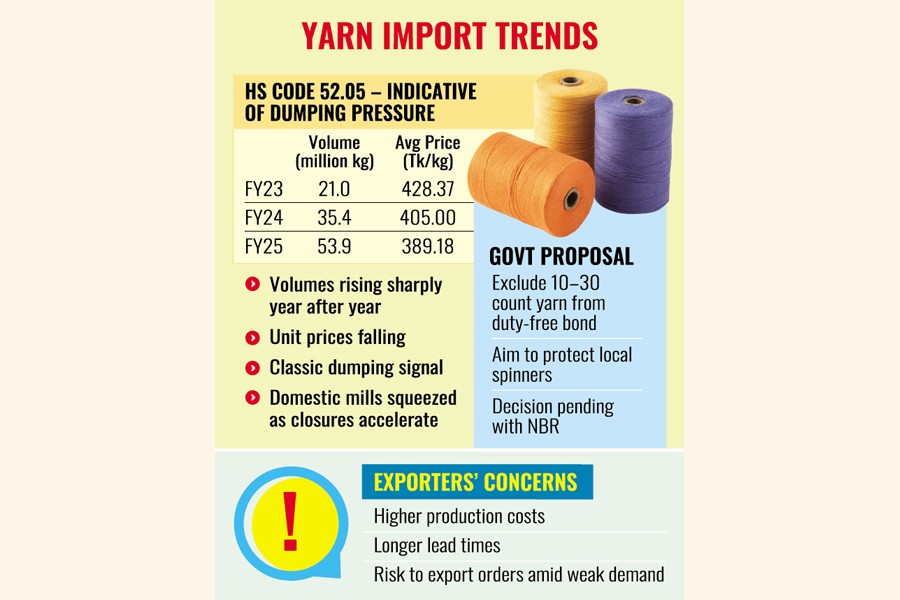
The Ministry of Commerce has recommended excluding imports of 10-30-count yarn from the duty-free bonded warehouse facility, citing the need to shield Bangladesh's local spinning industry from mounting pressure caused by low-priced imports.
The proposal has triggered sharp reactions from garment exporters, who fear the move could raise production costs and undermine the competitiveness of the country's apparel sector.
The ministry argues that continued duty-free imports threaten the survival of domestic yarn producers.
However, leading apparel bodies warn that restricting access to bonded facilities could disrupt supply chains, lengthen lead times and worsen the challenges facing exporters amid weak global demand.
The Bangladesh Garment Manufacturers and Exporters Association (BGMEA) and the Bangladesh Knitwear Manufacturers and Exporters Association (BKMEA) argue that restricting access to bonded facilities would increase production costs and weaken the sector's global competitiveness at a time when demand is already under strain.
In its recommendation, the commerce ministry cautioned that if domestic spinning mills continue to shut down, the knitwear sector could become entirely dependent on imported yarn.
Such dependence, it said, would reduce competitiveness, increase lead times, lower value addition and put additional pressure on foreign exchange reserves.
The final decision on whether the bond facility will be withdrawn rests with the National Board of Revenue (NBR).
The issue gained momentum after textile millers, in September last year, requested the Bangladesh Trade and Tariff Commission (BTTC) to intervene, alleging that low-priced yarn imports from India were threatening the survival of local spinners.
They claimed Indian exporters were dumping yarn in the Bangladeshi market, placing domestic producers at existential risk.
Endorsing these concerns, the commerce ministry formally wrote to the NBR on January 12, recommending that yarn of the specified counts be excluded from the duty-free bond facility.
NBR officials told The Financial Express that no formal order has yet been issued, but a decision is expected after a review of the ministry's proposal.
The ministry has also instructed that import bills of entry must clearly mention yarn counts in their commercial descriptions.
According to officials, yarn imports under the bond facility have risen sharply over the past two fiscal years, significantly reducing domestic sales.
At present, local spinning mills are operating at around 60 per cent capacity, while about 50 factories have already closed due to sustained losses. Industry stakeholders fear that more mills could shut down if the situation persists.
Garment exporters, however, see the proposed restriction as counterproductive. Fazlee Shamim Ehsan, executive president of BKMEA, told The Financial Express that some local yarn producers have already begun limiting supplies, with a few temporarily suspending orders.
He described the commerce ministry's move as arbitrary, arguing that excluding yarn from bonded facilities would raise production costs and force manufacturers to rely on more expensive local yarn.
"Imposing safeguard measures will not automatically make buyers accept higher costs," he said, adding that some international buyers have already voiced concerns.
Mr Ehsan also criticised the country's duty drawback system, calling it cumbersome and costly due to various ancillary charges.
He pointed to a persistent cost gap of 30-50 US cents per kilogram between Indian and Bangladeshi yarn and urged the government to consider alternative support mechanisms rather than tariffs or restrictions.
Md Shehabudduza Chowdhury, vice-president of BGMEA, warned that withdrawing the bond facility for Indian yarn could be viewed as a political signal by India, potentially straining bilateral trade relations.
He also noted that global demand for garments has fallen by 15-16 per cent, making even small cost increases significant enough to divert orders to competing countries.
"Closing access to bonded facilities will push up costs and threaten the survival of many garment factories," he said.
Mr Chowdhury added that the RMG sector depends on competitively priced imported raw materials and questioned who domestic spinners would sell their yarn to if garment factories became unviable.
He urged policymakers to weigh the broader economic implications before acting.
The commerce ministry, meanwhile, has linked the issue to Bangladesh's impending graduation from least developed country (LDC) status in November 2026.
After graduation, duty-free access to key export markets such as the EU, the USA, the UK and Japan will be phased out.
To retain preferential access, exporters will need to meet value addition thresholds of 40-50 per cent, with some schemes requiring double-stage value addition.
Officials argue that excessive reliance on imported yarn could make it difficult for knitwear producers to meet these requirements.
Former BTMA director Razib Haider Munna echoed this concern, warning that dependence on imported yarn could undermine Bangladesh's ability to maintain mandatory double-stage value addition after LDC graduation.
From the spinners' perspective, the threat is immediate.
A BTMA official said that despite the US imposing a 50 per cent reciprocal duty, Indian spinning production has remained unaffected, with exporters continuing to ship yarn to Bangladesh at low prices.
This, he said, has created uncertainty for local mills and jeopardised their ability to honour commitments to import US cotton, a key factor in narrowing the bilateral trade gap.
Citing import data, the official said yarn under HS codes 52.05 to 52.07 has seen rising volumes but declining unit prices-often viewed as a sign of dumping.
In FY2023-24, imports under HS code 52.05 rose 68.32 per cent by weight, while import value increased only 46.53 per cent.
Between FY2022-23 and FY2024-25, imports under the same code jumped from 21 million kg to 53.92 million kg, while per-kg prices fell from Tk 428.37 to Tk 389.18. In one HS 52.07 category, prices dropped by more than 63 per cent as volumes surged.
BTMA President Showkat Aziz Russell welcomed the Commerce Ministry's recommendation, alleging that Indian yarn is being sold 30-50 cents per kg below production cost, supported by provincial and state-level incentives.
He noted that the usual price gap is only 10-15 cents per kg and called for a detailed study and possible anti-dumping measures to protect an industry that has invested more than US$23 billion.
As the NBR prepares to decide, the debate highlights a growing policy dilemma: balancing the survival of domestic spinners with the competitiveness of Bangladesh's export-oriented garment industry at a critical juncture.
newsmanjasi@gmail.com
© 2026 - All Rights with The Financial Express

