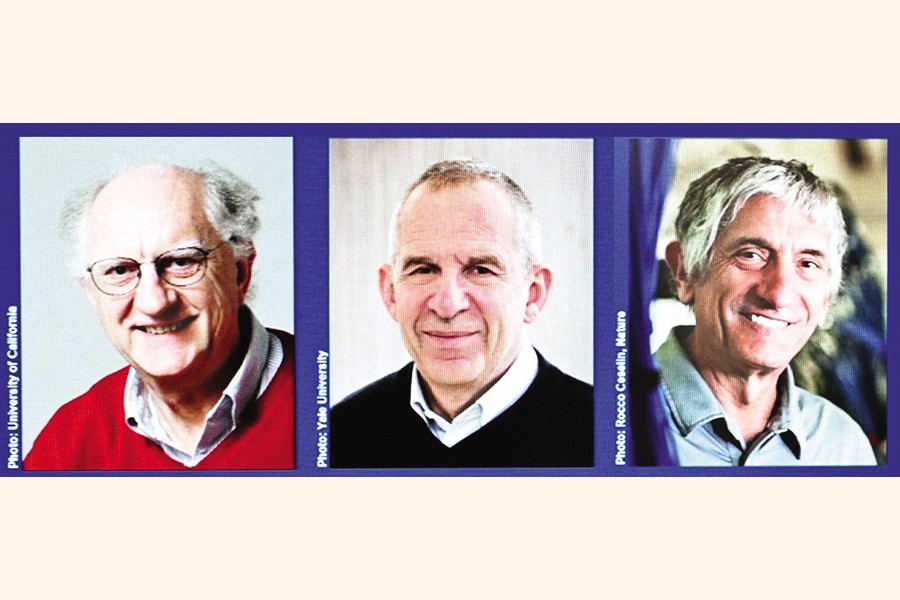
 (L-R) British physicist John Clarke at the University of California, USA, French physicist Michel H Devoret (University of California and Yale) and US physicist John M Martinis (University of California) are seen on a screen during a press conference on the awarding of the 2025 Nobel Prize in Physics at the Royal Swedish Academy of Sciences in Stockholm, Sweden, on Tuesday. — AFP
 STOCKHOLM, Oct 7 (AFP): Briton John Clarke, Frenchman Michel Devoret and American John Martinis won the Nobel Prize in Physics on Tuesday for work on quantum physics in action, the Nobel jury said.
The trio was honoured "for the discovery of macroscopic quantum mechanical tunnelling and energy quantisation in an electric circuit", the jury said.
Quantum mechanics describes how differently things work on incredibly small scales.
For example, when a normal ball hits a wall, it bounces back. But on the quantum scale, a particle will actually pass straight through a comparable wall -- a phenomenon called "tunnelling".
Tuesday's prize was awarded for experiments in the 1980s which showed that quantum tunnelling can also be observed on a macroscopic scale -- involving multiple particles -- by using superconductors.
In a series of experiments, the researchers demonstrated that "the bizarre properties of the quantum world can be made concrete in a system big enough to be held in the hand", the Royal Swedish Academy of Sciences said in a statement.
"This prize is awarding an experiment that brings the scale up to the macroscopic scale, scales that we can understand and measure through human standards," Ulf Danielsson, secretary of the Nobel physics committee and a professor of theoretical physics at Uppsala University, told AFP.
The jury noted that the discoveries had "provided opportunities for developing the next generation of quantum technology, including quantum cryptography, quantum computers and quantum sensors".
"It is wonderful to be able to celebrate the way that century-old quantum mechanics continually offers new surprises.
"It is also enormously useful, as quantum mechanics is the foundation of all digital technology," Olle Eriksson, chair of the Nobel Committee for Physics, said in a statement.
Clarke, 83, is a professor at the University of California, Berkeley.
© 2026 - All Rights with The Financial Express

