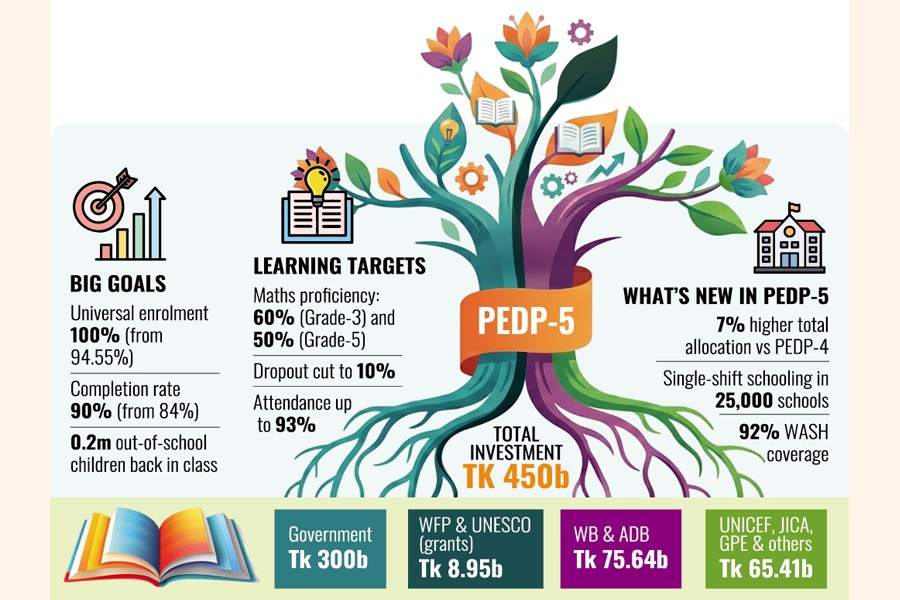
The government has initiated a Tk 450-billion programme to overhaul the country's primary education system to be implemented over the next five years beyond the existing development projects.
The proposed programme aims to narrow the persistent gaps in learning outcomes, achieve universal enrolment from the existing 94.55 per cent, raise the primary education completion rate to over 90 per cent from 84 per cent, and bring back around 0.2 million out-of-school children into the education system.
"The Ministry of Primary and Mass Education (MoPME) has sent the Development Project Proposal (DPP) for the Fifth Primary Education Development Programme (PEDP-5) to the Planning Commission and the Economic Relations Division (ERD)," said a senior official at the Planning Division.
The National Economic Council (NEC) in its recent meeting approved inclusion of the programme in the list of unapproved projects under the Revised Annual Development Programme (RADP) for the current fiscal year, the official added.
Under the financing plan, the government will provide Tk 300 billion, while the World Bank and the Asian Development Bank (ADB) have agreed to extend Tk 75.64 billion in loans.
Another Tk 65.41 billion is expected from UNICEF, JICA, the Global Partnership for Education and other development partners, while the World Food Programme and UNESCO will provide Tk 8.95 billion in grants.
Sources said the government formulated the Primary Education Development Programme (PEDP) for the education sector and the Health, Population and Nutrition Sector Programme (HPNSP) for the health sector in the late 1990s, integrating all major development projects under these programmes.
While the fourth phase of both the programmes ended in June 2025, the government decided to discontinue the sector approach in health and manage development through individual projects.
However, it opted to continue the sector-wide approach in primary education, paving the way for the formulation of the Fifth Primary Education Development Programme (PEDP-5), it was learnt.
The PEDP-4 concluded in June this year with a nine-year implementation period starting in July 2018 with a combined spending of Tk 328.03 billion -- Tk 188.26 billion domestic resources and Tk 139.78 billion foreign funding.
Analysis found that the allocation for the fifth programme is set to increase by 37.18 per cent, with a 59.36 per cent growth in domestic funding.
However, year-wise average allocation is set to increase by 147 per cent to Tk 90.00 billion from Tk 36.45 billion in the fourth programme in the proposed fifth programme.
Also the financing share of the development partners in the fifth phase is set to be reduced drastically to 33.33 per cent from 43 per cent in the latest phase.
The programme seeks to build an inclusive, equitable, resilient and sustainable primary education system, ensuring that all children, including out-of-school ones and those with disabilities, complete primary education with strong foundational literacy, numeracy, the proposal reveals.
According to the DPP, the programme sets specific learning and participation targets, including increasing mathematics proficiency to 60 per cent in Grade-3 and 50 percent in Grade-5, and reducing learning poverty by at least another 20 per cent
The primary dropout rate is targeted to be reduced to 10 per cent from 16.25 per cent, while net enrolment is expected to reach 100 per cent alongside full coverage of pre-primary education. Student attendance is projected to rise to 93 per cent under the programme.
The programme aims to help reduce dropout by 10 per cent from 16.25 per cent in 2024 and also increase student attendance rate to 93 per cent from 87.45 per cent.
A major focus of the programme is teacher professionalisation and system capacity building, while it will introduce a pre-service Diploma in Primary Education through the National Academy for Primary Education and Primary Teachers' Training Institutes, reveals the proposal.
The programme also gives emphasis on improving the school environment and strengthening resilience, with a plan to expand single-shift schooling to 25,000 schools, increase WASH coverage to 92 per cent and upgrade schools to meet child-friendly and climate-resilient standards.
Participation of children with disabilities is expected to increase by 20 per cent, while learning gaps across regions and socio-economic groups are projected to narrow.
Advisor to the Planning Commission Dr Wahid Uddin Mahmud said the Ministry of Primary and Mass Education has hurriedly submitted the PEDP-5 following the completion of the previous phase.
"Most of the programme activities are of a recurrent nature. In the future, such initiatives will be carried out under the revenue budget rather than as separate sector programmes," he told the FE.
Dr Mustafa K Mujeri, former director general of BIDS, said achieving quality education requires increasing the number, qualification, and training of teachers.
"Infrastructure development alone is not enough. Without recruiting and training competent teachers, qualitative improvements in education are not possible. To ensure quality education, teacher numbers, qualifications, and professional development must be enhanced," he added.
jahid.rn@gmail.com
© 2026 - All Rights with The Financial Express

