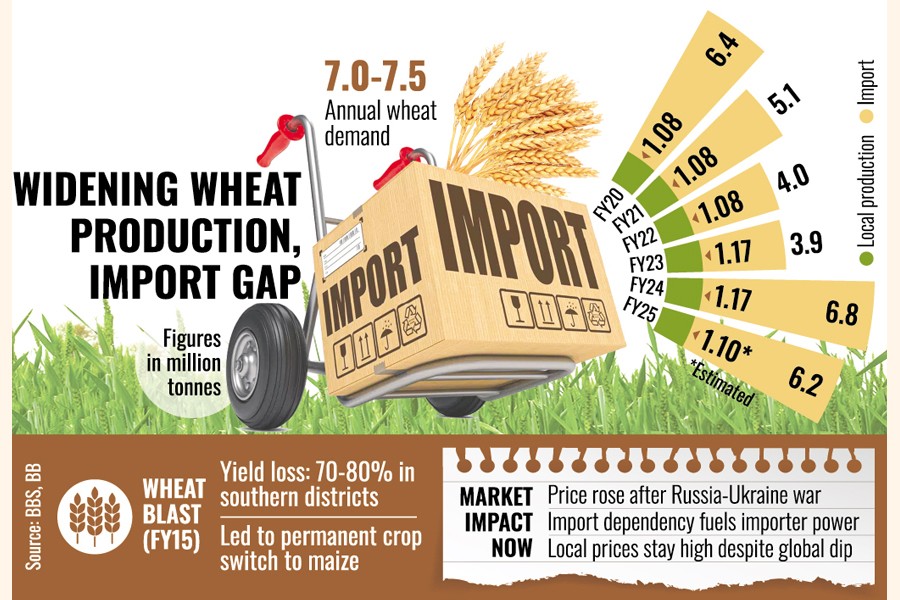
Bangladesh's reliance on imported wheat has hit a new high, with the country bringing in a record 6.2 million tonnes in FY24 -- the third-largest volume in its history -- as domestic production continues to fall short of growing demand.
A decade ago, wheat imports hovered between 2.5 to 3.0 million tonnes. The sharp rise is being attributed to a combination of factors including dwindling cultivation areas, a shift by farmers towards more profitable crops such as maize, and a lack of government incentives for wheat farming.
Official data from the Bangladesh Bank shows that the country's annual wheat demand now stands at around 7.0-7.5 million tonnes.
However, domestic production has declined to just 1.1 million tonnes in FY24 and may drop further by 0.1 million tonnes in FY25, according to an official from the Department of Agricultural Extension (DAE).
The official added that wheat acreage fell by 25,000 hectares this year, further worsening the supply gap.
In FY15, Bangladesh produced about 1.34 million tonnes of wheat while importing only around 2.0-2.5 million tonnes -- a stark contrast to the present scenario.
The DAE official also cited a devastating fungal disease known as "wheat blast", which spread in the southwestern districts during FY14 and FY15, reducing yields by 70-80 per cent in those areas. In the aftermath, many farmers permanently shifted to maize cultivation, which has since become dominant in several former wheat-growing zones.
Experts say wheat has become increasingly important in the Bangladeshi diet due to shifting consumption habits. "Even in rural areas, people are now opting for wheat-based items like bread, paratha, and roti during breakfast," said Golam Hafeez Kennedy, an agricultural economist.
"The expansion of the country's confectionery and agro-processing industries has also driven up wheat demand." Mr Kennedy emphasised the need for policy intervention to reverse the declining production trend.
"The agriculture and food ministry must incentivise local wheat farming. Otherwise, the growing reliance on imports will put further pressure on the economy," he added, noting that the annual import bill ranges from $1.3 billion to $2.0 billion depending on global prices.
Dr AHM Samsul Islam, professor of Agricultural Economics at Bangladesh Agricultural University (BAU), expressed similar concerns.
"Farmers have moved away from wheat largely because maize is more profitable and widely supported. In some cases, maize has even replaced rice." The BAU professor called for the introduction of climate-resilient wheat varieties and better price assurance for farmers to revitalise domestic wheat production.
According to him, up to 0.30 million hectares of fallow land in char (river islands) and haor (wetlands) areas could be brought under wheat cultivation, potentially adding another 1.0 million tonnes to local output.
Meanwhile, consumer rights groups warn that excessive dependence on imports is distorting the market.
SM Nazer Hossain, vice president of the Consumers Association of Bangladesh (CAB), said, "Importers and their affiliates now largely control pricing. Despite a fall in global wheat prices over the past 18 months, local consumers have hardly benefited."
He added that prices of wheat-based goods surged following the Russia-Ukraine war and have remained high since, raising questions about pricing mechanisms and market regulation.
As Bangladesh continues to grapple with food security concerns, experts agree that diversifying grain production and reducing import dependency should be high on the government's policy agenda.
tonmoy.wardad@gmail.com
© 2026 - All Rights with The Financial Express

