Bangladesh is going to enter a new constitutional era with a major overhaul of the country's democratic institutions as the "yes" vote won in the February 12 referendum.
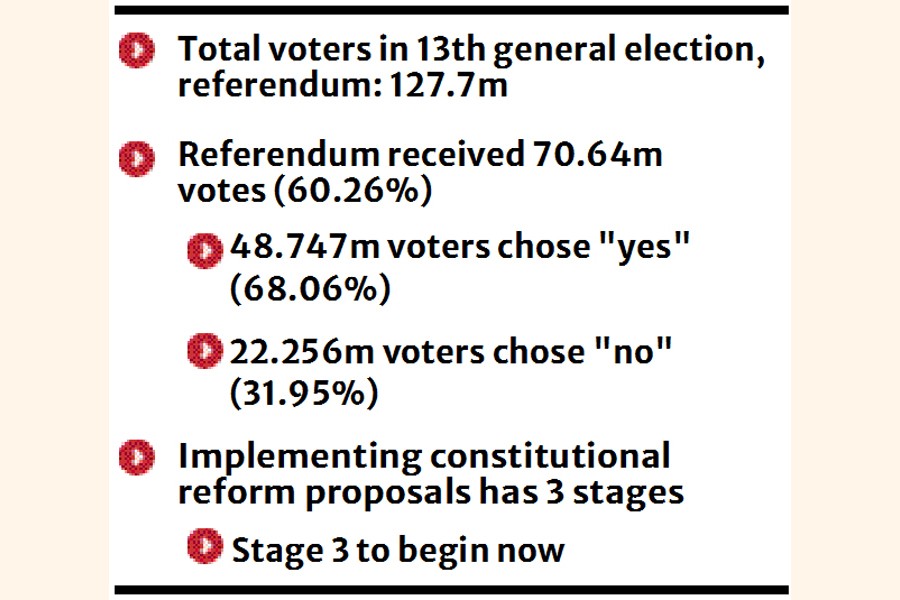
Out of the 70.64 million votes cast, 68.06 per cent of voters chose "yes" and 31.95 per cent marked "no", the Election Commission's (EC) provisional result showed.
In the referendum, the turnout was 60.26 per cent, with the total number of voters in the 13th parliamentary election and referendum being 127.7 million.
In the referendum, a total of 48.747 million voters gave "yes" vote, under which they endorsed the July National Charter.
On the other hand, a total of 22.256 million voters gave "no" vote, the EC data showed.
On November 13, 2025, President Mohammed Shahabuddin issued the July Charter implementation order, which effectively gave the EC authorisation to organise a referendum and make the necessary legal arrangements.
In several phases, the commission held 72 meetings with 33 political parties and alliances.
The discussions led to the drafting of the National Charter of July 2025, incorporating 84 recommendations, representing both unanimous agreements and some dissenting views from the participating political entities.
Basically, there are three stages in the implementation of constitutional proposals.
First is issuing orders to provide a legal basis, which was completed on November 13 through which the president issued the July National Charter (Constitutional Reform) Implementation Order 2025.
A referendum was held in the second stage of implementation.
This was held on the July Charter Implementation Order and the constitutional reform-related part of the July National Charter.
With the "yes" vote in the referendum, the third stage will now begin.
The "yes" victory in the referendum paved the way for the implementation of the reform proposals, including reducing the exclusive power of the prime minister to some extent and making appointments to constitutional posts through a committee comprising representatives of the ruling party, the opposition party, and, in some cases, the judiciary.
In addition, the scope of freedom of members of parliament (MPs) to vote on any issue in parliament will increase, the parliament will be bicameral, and constitutional amendments will be difficult in light of the demands of any one party.
But there is no scope for implementing constitutional proposals through ordinances or orders.
According to the reform proposal, a person can serve as the prime minister for a maximum of 10 years in his or her life.
In addition, a provision has been proposed that a person holding the post of the prime minister cannot simultaneously hold the position of the party chief.
© 2026 - All Rights with The Financial Express

