Entertainment is deeply intertwined with our culture and technology. We go through day-to-day life with so little space for entertainment, and then we move to bigger spaces for entertainment.
We open Facebook and Instagram Reels right after waking up. Elderly citizens are no exception in the times of technological advances. The generational gap makes a slight difference in how people consume AI content. People of all ages are consuming artificial intelligence-generated media regardless of their awareness.
The media is not indifferent to this technological advance, as it is rapidly growing in our digital world. It is unnecessary to mention that generative AI can also spread misinformation. Inexplicably unconvincing content roams social media, lacking authenticity or credibility.

A generative AI-made reel featuring harmful visuals, such as a girl being attacked by a dolphin while surfing, can fool viewers while they scroll for entertainment. This type of disturbing content creates stress. A senior citizen may not question its authenticity and may believe the facade is made for views.
The reel scrolling on popular social media platforms like Facebook, Instagram and TikTok implies how the entertainment industry shapes our leisure time.
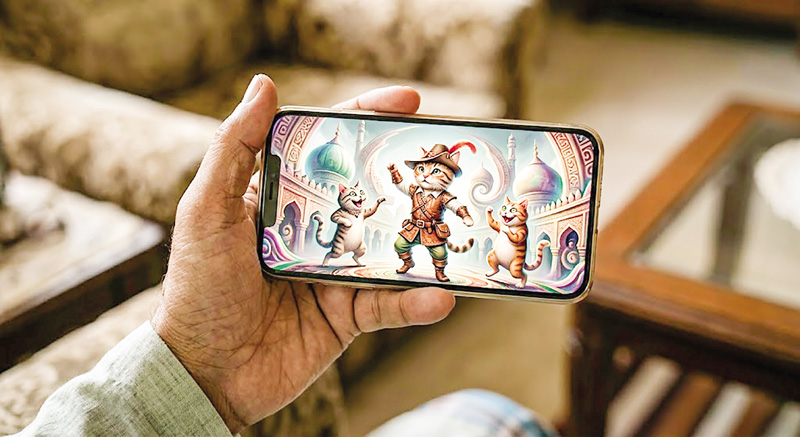
The cat videos showing human-like social gestures, which are relentlessly impractical and repetitive, are used to produce dopamine (a neurotransmitter known as a feel-good hormone) and can help with short-term entertainment. But it has no meaningful follow-up that can attract people for any longer.
An older adult in their leisure time may enjoy the dopamine rush. Still, it is not a healthy way to consume it regularly. This type of unreal content can be mistaken for human-made animation by those without knowledge of artistic or generative AI.
Dr Mahfuzul Haque (52), a physician in BMU, shares his thoughts, saying, "I miss those days when there were no other options for entertainment other than radio and traditional else." He is not really fond of social media for entertainment. His opinion on generative AI reels implies that the themes of this type of reel are perhaps good, but the content is not always up to date.
On the contrary, we cannot generalise this perspective as people in our country have limited access to technological advancement. Moreover, artificial intelligence is a relatively new and popular field in the 2000s.
Radio is still an entertainment industry that evokes nostalgia among senior citizens today. They were the first generation to grab a radio in their free time. Radio spread its wings to get more closely connected, as it can be listened to on mobile phones. In July 2024, people clung to a radio channel to learn about the country's situation as the internet blackout lasted for a few days due to national political unrest.
Radio was still popular in the 2010s before 4G and 5G internet connections became more widely available, along with social media. People of all ages listened to different radio shows based on their preferences.
School-going students listened to teen-oriented shows and discussed them the next day with their peer groups. Horror shows like Bhoot FM were a fascination all across the country.
People listen to the radio while commuting in their private vehicles, as the radio connection is integrated with the vehicle. News updates and songs are chronic elements in radio channels. People never stopped consuming radio, but new media content began to replace some of its space.
Now, younger generations are aware of AI-generated reels and still follow them for relaxation. Because they do not have a choice other than scrolling through their reel feed in the short, fast free time they get to rest.
They learn to use artificial intelligence in their fast-track lives. Henceforth, they are aware that generative AI can make reels too. But the question is, are the senior citizens aware of what they are consuming for entertainment?
K M Saidur Rahman Sayeed (54), a doctor of veterinary medicine at Peoples Poultry & Hatchery Ltd, heralds that he does not enjoy generative AI reels at all. He said, "I do not really miss old ways of technologies for entertainment, but I like non-generative AI or human-made reels sometimes."
There are different types of generative AI content floating around social media. Dancing, singing, drawing, etc.: content is deliberately created with AI tools, and views can be easily gained to earn money on social media.
The caricatured art on social media can be deceptive. Some content creators do not use disclaimers when using generative AI in their content. It may even infringe on the copyright of the actual artist if the content is based on borrowed inspiration from that artist.
Some renowned artists cum Japanese animation directors, like Hayao Miyazaki in 2016, opposed the use of generative AI in creating animated cartoons.
The Japanese animation industry is a major success worldwide in the entertainment media industry. But a prompt in AI to create a Ghibli art can look similar to human-made animation, which is an output of artistic practice and effort.
This similarity is not acceptable to some animation artists. Generative AI can even sing songs, and it is a content itself streaming on platforms like YouTube.
Animated reels, which are not human-made, can feel soothing for passive audiences. But it lacks life and meaning for the audience to consume, unlike human-made animated art. These reels are created with repetitive patterns. There is no creativity or newness for the audience. Because generative AI cannot produce genuinely new patterns beyond those it was trained on.
Here comes a question: "Where do we draw the line between human-made and generative AI-made animated reels?" AI' slop' blurs the line. AI' slop' is a perpetuating content exposure on social media that disseminates misinformation, disinformation, malinformation, clickbait, and just 'for the sake of views' content creation.
Some artists argue that the blurry line between human-made and AI-generated art trivialises artistic practices. On the other hand, it may try to shape the audience.
For instance, people knowingly consume AI-generated reels to feel stress-free. Thus, it is shaping the media to flow at a mindless pace. Henceforth, some elderly citizens in our country do not bother to check the authenticity of a reel they are watching for solely 'entertainment' purposes.
The reel can be 'anything' visualising. So, the visualisation of content can be disturbing while searching for 'entertainment'. For example, AI' slop' does not wait to ruin the algorithm of a user who is on the platform for their leisure time only.
Distressing slop may appear and abruptly interrupt the 'entertainment' pondering of an elderly person. It may cause 'brainrot'. A retired school teacher, devouring 'brainrot' in their free time, can cause mental or intellectual dysfunction.
sanjidahossainfariha365@gmail.com
© 2026 - All Rights with The Financial Express

