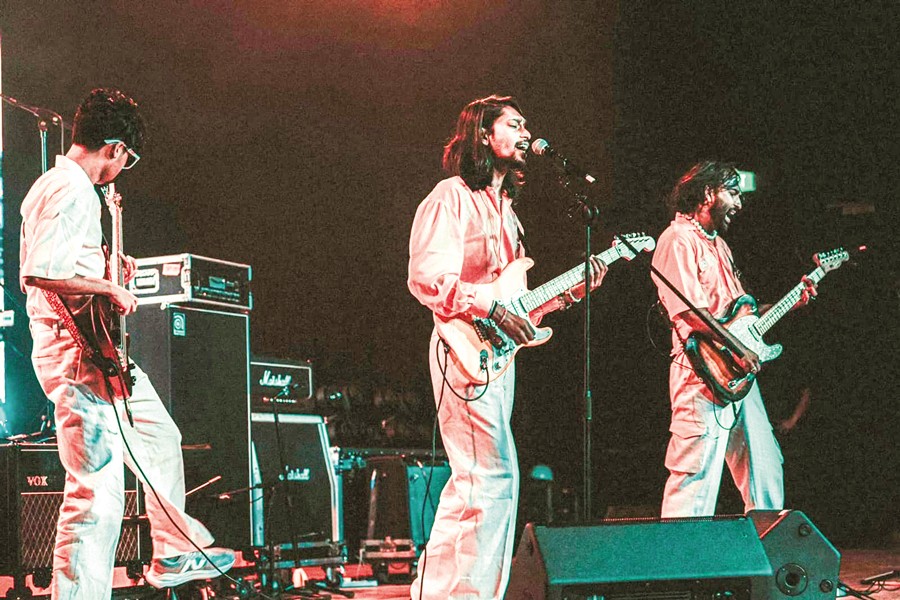
 Dads in the park
 On a slow weekend afternoon in Dhaka, Spotify shuffled to a song less heard. It began with a strangely familiar image: “Rooftops and crows/And guitars and away we go.” The song “Crows” by Orford mentions rooftop hangouts, the unnoticed birds in the grey skies, and the laughter and heartbreak of a restless city youth. This felt like Dhaka condensed into a melody.
A few months ago, on a trip to Sri Lanka, I struggled to explain to newly made foreign friends what life in Dhaka feels like for its young generation. The long nights spent with guitars and engaging in long conversations, and the contradictions of being connected to the world but trapped in traffic every day.
That afternoon, it struck me: the stories were already being told in English. These indie bands are quietly building the soundtrack of our urban lives.
Take Orfred’s Crows. Its imagery of unnoticed crows flying overhead reflects a generation trying to carve an identity in a city that barely stops to see them. Beneath the whimsy lies melancholy, as youth tries to find meaning in a city that refuses to slow down.
But Orfred is not limited to rooftops and smog. In Jaflong, they trade the concrete jungle for rivers and mountains. The borderlands of Sylhet become a metaphor for heartbreak and resilience: “You can break the land/but the river won’t stand between us.” Love and separation blur into geography, while intoxicated nights by the river reflect the recklessness of coping with loss. Both songs are written in English, yet they feel unmistakably Bangladeshi. They are rooted in crows, rivers, borders, and youth wandering between escape and endurance.
EIDA’s Nightdriver shifts to motion, racing through neon-lit streets: “Is anybody holding me, this cold in me?” It captures the restlessness of night drives through Dhaka, the search for warmth and a sense of belonging amid alienation. Both songs share the same heartbeat: the anxiety of being young, the desire to be seen, and the fragility of connections in this bustling city.
Together, these four tracks — Crows, Jaflong, Lullaby, and Nightdriver — give us something rare: a sonic window into Dhaka’s youth psychology. They sing of rooftops and rivers, lies and night drives, but they all circle back to the same question. How do you find meaning, intimacy, and identity in a city that is both too crowded to notice you and too lonely to hold you?
In Dhaka’s music scene, these groups are sometimes jokingly referred to as “English-medium bands,” a playful dig at their preference for the English language. Yet this choice is not about alienation from Bangla culture. Instead, it reflects the dual reality of Dhaka’s youth. Like scrolling memes in English, watching Netflix and anime, debating politics in tea stalls, and navigating a city that is as global as it is local.
Writing in English allows these bands to bridge audiences. Their peers in Dhaka understand them. After all, English is the language of schooling, the internet, and much of urban youth slang. But English also opens the door for global listeners who would never otherwise hear Dhaka’s crows or the scenic borderlands of Jaflong. When Orfred sings about Jaflong or when Dads in the Park hums a lullaby of lies, they are inadvertently exporting a culture that is uniquely Bangladeshi yet instantly legible abroad.
Meet the Bands
Orfred
Orfred was formed in the early 2010s. They spent years refining their sound into atmospheric indie rock, characterised by poetic lyrics. Their recent album, Wonderland, features songs like “Crows,” “Jaflong,” and “Eliza.” These tracks strike a balance between melancholy and escape, drawing on both Dhaka rooftops and Sylheti rivers. YouTube, Bandcamp and Spotify carry their thoughtful and often surreal reflections on love, loss, and the city.
Dads in the Park
Two BRAC University friends began jamming in 2014. That effort became Dads in the Park, one of the most recognisable English-language acts from Bangladesh. Tajwar Ul Islam and Ishmam Selim Chowdhury make up the group. Their breakout single Lullaby gained wide attention. The band’s vulnerability and dreamy guitar work reached listeners at home and abroad. They moved from small stages in Dhaka to the Hammersonic Festival in Indonesia. Their story demonstrates that Bangladeshi indie music can transcend borders while retaining its local essence.
EIDA
EIDA’s sound is polished and pop-oriented but still haunting. Musicians with backgrounds in rock and metal formed the group. Members are Samiul Haque on vocals and guitar, Raihan Mahbub Rasha on percussion, Sakib Manzur Zihan on guitars and loop station, Hassan Munhamanna on vocals, and Arjo Biswas on bass. Their track Nightdriver highlights a blend of indie pop and rock. It combines dreamy tones with lyrics about longing and disconnection. EIDA reflects a younger generation of Dhaka musicians. They carry global indie influences but shape them with the restless mood of Dhaka nights.
Embers in Snow
Embers in Snow is the solo project of Rakat Zami, who is currently based in Toronto. His music leans toward dream pop and shoegaze. The songs feature lush soundscapes and lyrics that explore longing, memory, and nature. Albums and EPs such as Solstice, Northern Tales, and This Is Us include tracks like Moires, Flight, Hourglass, and The Woods. Forests and snow act as metaphors for love and separation. The “Stories Untold” concert at the Liberation War Museum in Dhaka was the last live show of Embers in Snow before Zami’s move abroad. The music continues online and carries Dhaka’s indie voice beyond its borders.
Together, these bands tell something important about Dhaka today. The city’s youth are not content to be shaped only by old Bangla rock or by Western playlists. They are building a hybrid identity. They sing in English yet dream in Bengali. They write about crows and rivers, heartbreak and sleepless nights. Their music is not an escape. It is a translation. It takes Dhaka’s contradictions, anonymity, humour, and longing and turns them into a language that outsiders can hear.
For decades, Bangladesh’s story abroad has been told through garments, floods, or politics. Listen instead to Orfred’s crows, Dads in the Park’s lullabies, EIDA’s night drives, or Embers in Snow’s winter landscapes. You will hear another story. It’s the story of a restless generation sitting on rooftops, strumming guitars into the night, finding ways to fly even when no one is watching.
contact.iftekhar.tne@gmail.com
© 2026 - All Rights with The Financial Express

