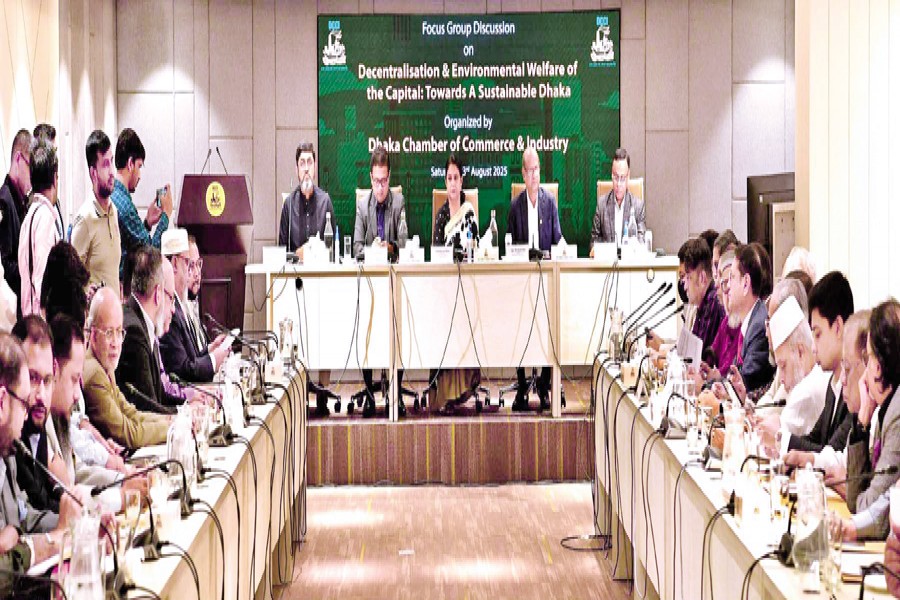
 Adviser of the Ministry of Environment, Forest and Climate Change Syeda Rizwana Hasan speaks at a discussion titled 'Decentralisation & Environmental Welfare of the Capital: Towards a Sustainable Dhaka,' organised by the Dhaka Chamber of Commerce and Industry (DCCI) at its office in the city's Motijheel area on Saturday. RAJUK Chairman Reazul Islam was present as the special guest, while DCCI President Md Taskeen Ahmed made the welcome address. —PID
 FE REPORT
Ensuring national development, creating employment opportunities and enhancing digital connectivity in different regions of the country are vital to decentralising pressure away from Dhaka, speakers said at a programme on Saturday.
They underscored the need for establishing satellite towns with all required facilities around Dhaka, developing a multimodal transport network, and ensuring better coordination among the authorities concerned.
The speakers deplored the fact that Dhaka city has been losing its liveability due to multiple factors, including climate change, unplanned urbanisation, river encroachment and pollution, environmental degradation, excessive use of polythene and other non-biodegradable elements, and unbearable traffic congestion.
They made the observations at a focus group discussion titled 'Decentralisation & Environmental Welfare of the Capital: Towards a Sustainable Dhaka,' organised by the Dhaka Chamber of Commerce and Industry (DCCI) at its office in the city's Motijheel area.
Adviser of the Ministry of Environment, Forest and Climate Change Syeda Rizwana Hasan attended the event as the chief guest, while RAJUK Chairman Reazul Islam was present as the special guest. DCCI President Md Taskeen Ahmed made the welcome address, followed by a keynote presentation by architect Iqbal Habib, an environmental activist.
Speaking on the occasion, Syeda Rizwana Hasan said it is essential to ensure liveability in adjacent cities such as Savar, Narayanganj, and Gazipur on a priority basis to help ease pressure on Dhaka. There are a lot of housing projects in Dhaka but still there are thousands of homeless people, she said, adding that victims of river erosion and other climate change impact are heading for the capital for their survival. "We can't provide the victims of river erosion with khasland, as other (influential) people occupy them," she said.
She also called upon the industrialists to be more conscious about environment. "When we launch drive against dyeing factories to curb pollution, please cooperate with us," she said drawing the attention of DCCI office-bearers and other similar trade bodies to the issues. The government is also working to make the CETP of Savar tannery functional, she added.
In his speech, RAJUK Chairman Reazul Islam said without ensuring sustainable development across the country, it is impossible to build a sustainable Dhaka. "Unfortunately, we've failed to achieve that goal as there is still no real alternative to the capital as the primary source of employment," he said.
He stressed the need for an integrated development plan for Dhaka and proposed that all types of development activities should be brought under the umbrella of a single authority to ensure accountability.
Presenting the keynote paper, Iqbal Habib said although 32 per cent of the country's urban population lives in Dhaka, the city suffers from an alarming shortage of greenery and increasing heat stress, making life increasingly difficult.
He pointed out that over-centralisation has led to growing problems such as flooding, water-logging, poor waste mismanagement, urban pollution, and public health crises. He laid stress on balanced urbanisation and improvement of rural livelihoods to decentralise Dhaka. The architect also suggested implementing the proposed ring roads surrounding Dhaka considering them major communication corridors.
DCCI President Taskeen Ahmed said that Dhaka alone contributes 45 per cent to the national GDP, but according to a BUET study conducted in 2022, traffic congestion in Dhaka alone causes a daily loss of working hours equivalent to Tk 1.40 billion.
In order to reduce Dhaka's pressure and ensure decentralisation, he stressed the need for transforming the adjacent areas of Dhaka into secondary cities for administrative and commercial purposes. He observed that there is no alternative to coordinated initiatives from both public and private sectors to make Dhaka a livable and sustainable megacity.
Dr Shamsul Hoque, a professor of civil engineering at the BUET, said that instead of improving the public transport system, there has been too much focus on mega projects, leading to rising costs without delivering tangible benefits. He called for structural reforms in the planning framework for integrated national development.
Dr. Adil Mohammed Khan, President of Bangladesh Institute of Planners (BIP), Liakat Ali Bhuiyan, Senior Vice President, Real Estate and Housing Association of Bangladesh (REHAB), former Vice President of DCCI M. Abu Horaira, Geographer and Urban Planner of Dhaka North City Corporation (DNCC) Dilbahar Ahmed and Chief Town Planner of RAJUK Ashraful Islam spoke, among others.
saif.febd@gmail.com
© 2026 - All Rights with The Financial Express

