FE REPORT
The low rates of birth and death registration in Bangladesh are significantly hindering the protection of citizens' rights, public health planning, and effective development management, experts said at a workshop on Wednesday.
Currently, the birth registration rate in Bangladesh stands at only 50 per cent, while the death registration rate is 47 per cent.
Coordination among the government agencies concerned, particularly between the Health Division and the Local Government Division, can improve the situation, as 67 per cent of child birth in the country is taking place in healthcare facilities, they added.
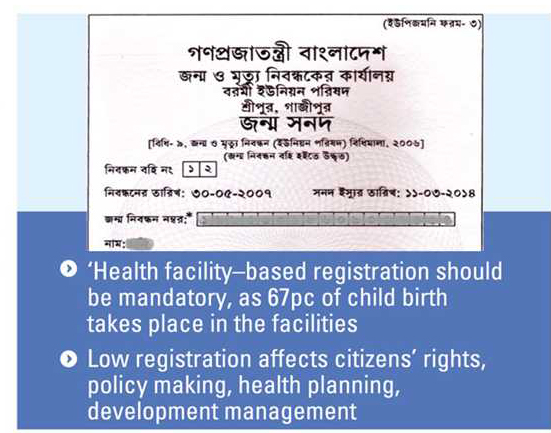
Furthermore, reforming the existing Birth and Death Registration Act and making health facility-based registration mandatory is one of the most urgent policy priorities, speakers said at the journalists' workshop titled 'Birth and Death Registration in Bangladesh: Progress, Challenges and Way Forward'.
The two-day workshop was organised by PROGGA (Knowledge for Progress) with support from the Global Health Advocacy Incubator (GHAI).
The workshop, held at the Bangladesh Medical Association (BMA) Bhaban in the city on March 3-4, brought together 32 journalists working in print, television, and online media.
Although thousands of people are born and die every day, nearly half of these events are not included in the official records. As a result, a large number of citizens remain outside the state's administrative system.
Experts noted that birth and death registration is a fundamental means for ensuring legal identity, access to education and healthcare, inheritance rights, social protection, and voting rights.
Citizens without registration become socially and economically invisible, increasing their vulnerability to child labour, child marriage, human trafficking, and discrimination.
Furthermore, the absence of reliable birth and death data undermines effective development planning and evidence-based policymaking, they added.
Under the current law, the responsibility for registration largely rests with families, while health facilities are not legally required to ensure registration.
However, nearly two-thirds of the births in Bangladesh now take place in healthcare facilities. Due to the lack of an automatic registration system, many births remain unregistered.
The South Asian countries, like the Maldives, Bhutan and Sri Lanka, have achieved near-universal registration by introducing health facility-based registration systems. Experts opined that similar system is urgently needed in Bangladesh.
Md. Nazrul Islam, Country Coordinator of Vital Strategies, said, "Alongside reforming the existing law, effective implementation must be ensured to attain universal birth-death registration."
Muhammad Ruhul Quddus, Bangladesh Country Lead of GHAI, said, "Assigning registration responsibilities to healthcare facilities will help Bangladesh achieve the target of universal registration set by UNESCAP, as well as the Sustainable Development Goal (SDG) 16.9, which aims to provide legal identity for all."
Sajjadur Rahman, Deputy Editor of The Business Standard, said, "In order to make reforming the birth and death registration law a national priority, the media must push the policymakers by publishing continuous reports highlighting the multi-faceted need for registration."
ABM Zubair, Executive Director of PROGGA, was also present as a discussant. PROGGA's Head of Programmes Md. Hasan Shahriar and Coordinator Mashiat Abedin delivered presentations in the workshop.
nsrafsanju@gmail.com
© 2026 - All Rights with The Financial Express

