Banks saw a noticeable shift in deposit behaviour in the July-September quarter of 2025, with more funds flowing into term deposits as rising returns encouraged customers to lock in their savings for longer tenures.
In this period, fixed deposit receipts (FDRs) in banks rose by about 5.53 per cent to Tk 9.93 trillion from Tk 9.41 trillion in the preceding quarter.
FDRs maintained a steady upward trajectory over seven quarters, growing from Tk 7.91 trillion in the January-March quarter of 2024 to Tk 9.93 trillion at the end of July-September 2025.
The growth was marked by incremental rises throughout 2024, moving from Tk 8.22 trillion in April-June 2024 to Tk 8.48 trillion in July-September and reaching Tk 8.75 trillion at the end of October-December.
The most significant momentum was observed in the first quarter of 2025, which saw the largest quarterly jump of Tk 350 billion compared to the October-December period of 2024.
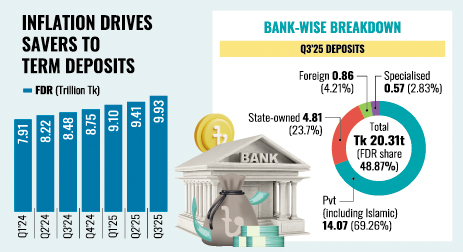
The share of FDRs in the banking system's total deposits rose to 48.87 per cent in July-September 2025.
Of the total deposits of Tk 20.31 trillion at the end of the July-September 2025 quarter, state-owned banks accounted for Tk 4.81 trillion, representing 23.70 per cent of the figure.
Specialised banks held deposits of Tk 574.09 billion (2.83 per cent), foreign banks Tk 855.89 billion (4.21 per cent), and private commercial banks, including Islamic banks, Tk 14.07 trillion (69.26 per cent).
Islamic banks alone mobilised deposits worth Tk 3.93 trillion, accounting for 19.33 per cent of the total.
FDRs are available for tenures of less than six months, six months to less than a year, a year to less than two years, two years to less than three years, and three years or more.
Experts say the surge in FDRs reflects growing risk aversion among savers amid persistent inflationary pressures.
"With uncertainty in equity and bond markets, many depositors prefer the safety and predictable returns of term deposits, even if it means locking their funds for longer periods," notes a senior economist .
Meanwhile, business stakeholders say the trend may have broader implications for credit growth.
"While higher fixed deposits strengthen banks' funding base, it could also push up lending rates, as banks balance the cost of funds with the need to maintain profitability," says a representative of a local trade association.
Dr Masrur Reaz, chairman of Policy Exchange of Bangladesh, says, "Rising interest in term deposits is a positive signal of confidence in the banking system."
"However, policymakers need to ensure that this growing pool of long-term savings is efficiently channelled into productive investments rather than sitting idle in low-yield accounts," he says.
A balance between attractive deposit schemes and sustainable credit growth is the key to supporting both savers and the wider economy, he adds.
sajibur@gmail.com
© 2026 - All Rights with The Financial Express

